
Bougainvillea


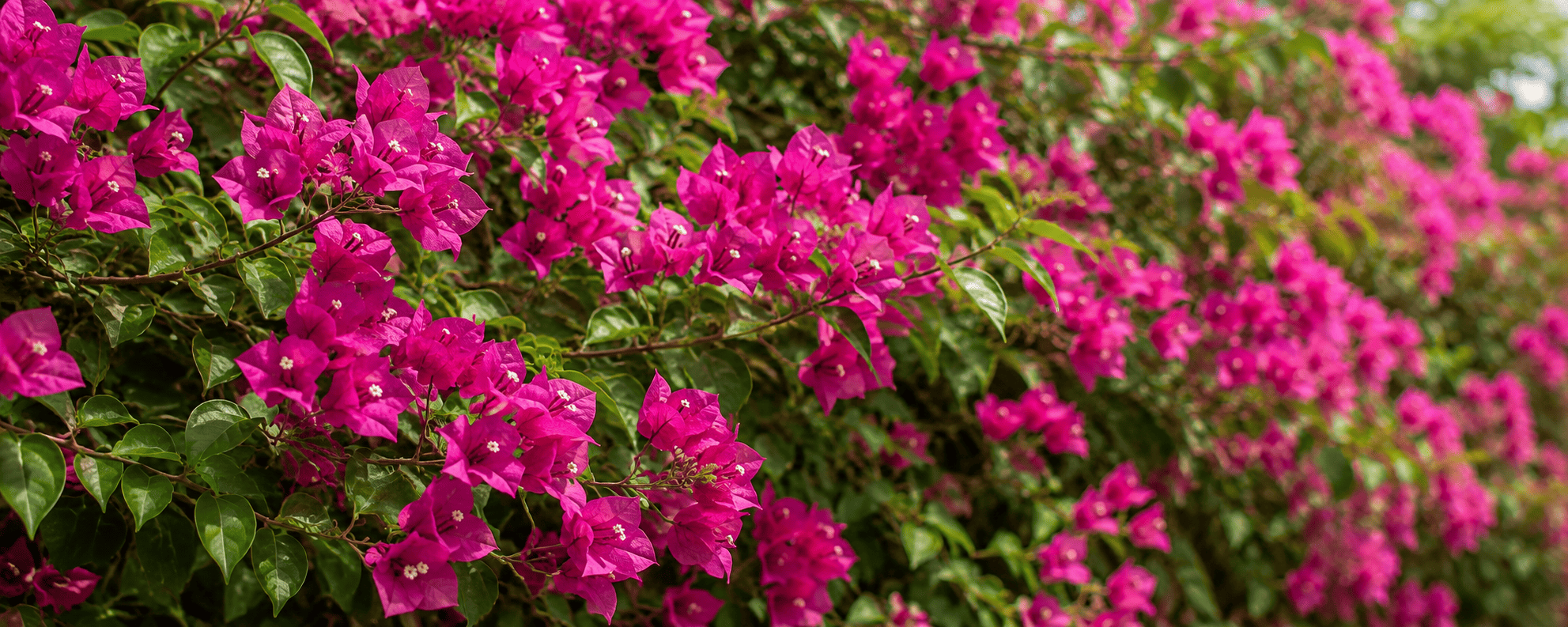
- Watering Guidelines: Drought-tolerant once established. Water thoroughly only when the soil has dried out significantly. Excessive moisture, especially during cooler dormant periods, often leads to root rot and diminished flowering.
- Growth Conditions: Demands full, intense sun (minimum 6–8 hours daily). Thrives in poor to average, highly well-draining soil. Avoid heavy fertilizers; nitrogen-rich feeds favor leafy vine growth over the production of iconic, colorful bracts.
- Vulnerabilities: Sensitive to cold (frost-tender) and poor soil drainage. Susceptible to aphids and spider mites if airflow is restricted. Its most challenging trait is its aggressive, thorny growth, which requires consistent, strategic pruning to manage.
- Growth Habit: A woody, perennial vine or scrambling shrub capable of scaling walls, trellises, or fences to impressive heights.
- Root System: A delicate, non-invasive but sensitive root system that does not tolerate disturbance; container specimens should be repotted with extreme caution.
- Bract Structure: The showy components are actually modified leaves known as bracts. They are thin, papery, and range in color from magenta and red to orange, white, and yellow.
- Foliage Detail: Alternate, ovate-shaped leaves that are typically a deep, rich green. Some varieties feature variegated foliage, adding interest even when the plant is not in bloom.
- True Flowers: The actual flowers are small, inconspicuous, white or cream-colored tubular structures that emerge from the center of the larger, vibrant bracts.
- Defense Mechanisms: The plant is well-known for its sharp, curved thorns that act as a mechanical defense and a hook for climbing, making handling difficult without protective gear.
- Stem Characteristics: Rapidly growing, woody stems that harden and thicken as they mature, allowing the plant to support itself and its expansive canopy over architectural structures.
Non-Toxic but Thorny: Bougainvillea is classified as non-toxic to humans and common household pets. However, it requires careful handling due to the presence of sharp, stiff thorns along its woody stems. It is best suited for locations where it will not pose a physical hazard to children or pets.
To Humans & Children
Non-toxic upon ingestion. The primary hazard is physical injury from thorns. Always use thick gloves and eye protection when pruning. Contact with the sap can occasionally cause mild contact dermatitis in sensitive individuals.
To Household Pets
Non-toxic to cats and dogs. Ingestion of the bracts or leaves is unlikely to cause poisoning, though the sharp thorns and fibrous texture can cause significant mouth or throat irritation if chewed.
Pruning & Safety Protocol
Always wear puncture-resistant gloves and long sleeves when working with Bougainvillea. The thorns are deceptive and can easily penetrate soft fabrics. If pruning near walkways, ensure all lateral branches are cleared to prevent accidental contact.