
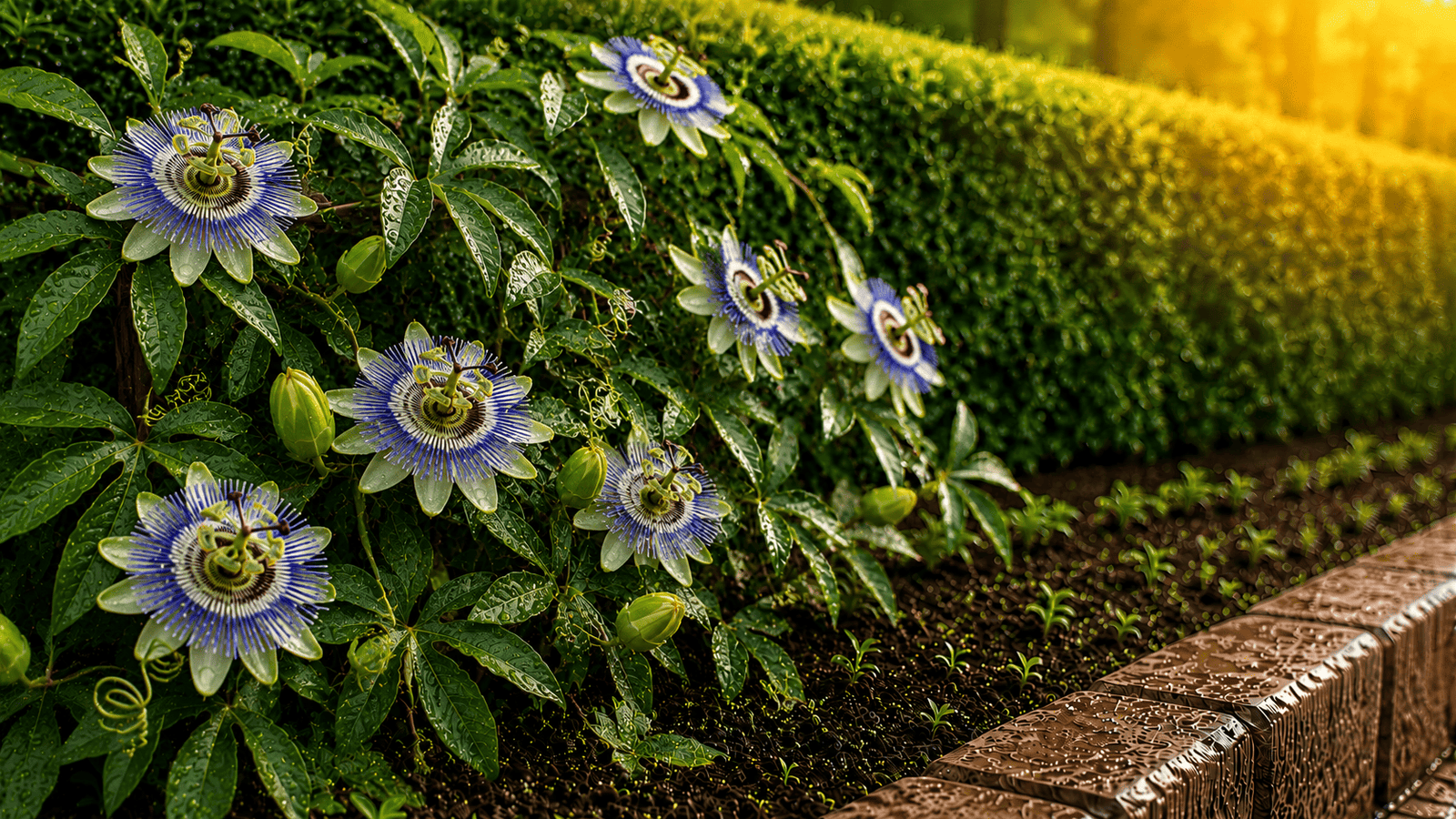
Family: Passifloraceae (Passion Flower Family) Lifespan: Vigorous Woody Perennial Vine

Blue Passion Flower

Passiflora caerulea
🌀 Complex Blossoms 🌿 Fast Climber 🦋 Pollinator Magnet

History & Taxonomy
Native to South America (primarily Argentina, Brazil, and Peru), the Blue Passion Flower (Passiflora caerulea) belongs to the passion flower family (Passifloraceae). It was first formally described and classified by the Swedish botanist Carl Linnaeus in his landmark 1753 work Species Plantarum. Spanish Christian missionaries in South America famously reinterpreted the intricate flower parts as religious symbols of the Passion of Christ—viewing the corona filaments as the crown of thorns, the five stamens as the wounds, and the three stigmas as the nails. Today, it is globally celebrated as a vigorous, fast-growing ornamental vine prized for its mesmerizing, geometrically complex blossoms and attractive palmately lobed leaves.

Botanical Culture & Distribution
Thriving across subtropical and warm temperate regions worldwide, Passiflora caerulea has naturalized extensively due to its remarkable vigor and hardiness compared to other tropical passionflower species. Cultivated widely on trellises, arbors, and garden walls, it serves as an exceptional host plant for butterfly larvae (such as the Gulf Fritillary) while producing ornamental, egg-shaped orange-yellow fruits. Its lush climbing habit and striking floral architecture make it a favorite among gardeners seeking both dramatic vertical interest and high ecological value.

Cultural & Practical Usage

Ornamental & Trellis Climbing

Widely cultivated as a vigorous, fast-growing climbing vine on fences, trellises, arbors, and garden walls. It is highly prized for its mesmerizing, intricate blue-and-white blossoms that provide dramatic vertical interest and attract pollinators.

Fruit & Herbal Uses

Produces oval, egg-shaped orange-yellow fruits (granadillas) containing edible pulp. While less flavorful than other passion fruit species, the fruits are edible, and leaves are occasionally used in traditional herbal calming teas.

Symbolic & Wildlife Value

Historically rich in symbolism, Spanish missionaries linked its complex floral anatomy to the Passion of Christ. Ecologically, it serves as an essential larval host plant for butterflies and a nectar source for bees and pollinators.

Propagation Methods

Easily propagated through semi-hardwood stem cuttings taken during spring or summer, or grown from seed. Cuttings root reliably when placed in a warm, moist potting medium with high ambient humidity.

Blue Passion Flower Climber Display
Passion Flower Vine Display
  • Watering Guidelines: Keep the soil consistently moist during the spring and summer growing seasons. Water deeply when the top inch of soil feels dry, but ensure excellent drainage to prevent waterlogging.
  • Growth Conditions: Thrives best in full sun to partial shade (at least 6 hours of sunlight daily encourages heavier blooming). Prefers fertile, loamy, well-draining soils with neutral to slightly acidic pH.
  • Vulnerabilities: Generally hardy and robust, but can occasionally attract caterpillars (such as Gulf Fritillary larvae) or spider mites. While root-hardy down to USDA Zone 6, severe freezing temperatures will cause top-growth dieback.
  • Growth Habit: Fast-growing, vigorous woody-stemmed evergreen or semi-evergreen climber that scales structures using specialized axillary tendrils.
  • Root System: Strong, spreading root system that produces underground runners, allowing established vines to vigorously rebound after frost.
  • Leaf Structure: Deeply palmately divided leaves typically featuring five distinct, smooth-margined lobes arranged in a star-like pattern.
  • Foliage Detail: Lustrous, dark green leaves that provide a lush, dense backdrop for the striking, geometrically complex flowers.
  • Bloom Lifespan: Individual complex blossoms generally remain open for a single day, but flowers are produced in continuous succession throughout summer and autumn.
  • Floral Morphology: Intricate, radially symmetrical flowers featuring pale greenish-white petals, a prominent central corona of blue, purple, and white filaments, and a central staminal column.
  • Stem Characteristics: Pliable green climbing vines that mature into tough, woody stems capable of covering extensive trellises and arbors.
SAFETY: Mild Toxicity & Cyanogenic Compound Warning

Cautionary Profile: While certain parts of the Blue Passion Flower (Passiflora caerulea) are edible or used traditionally, unripe fruits and vegetative components contain cyanogenic glycosides and minor alkaloids that can be toxic if consumed in large quantities improperly.

To Humans & Children

Unripe green fruits and excessive ingestion of raw leaves or stems can cause stomach discomfort, nausea, and mild cyanide-related symptoms due to cyanogenic compounds. Fully ripe orange fruits are edible in moderation.

To Household Pets

Mildly toxic to dogs and cats. Ingestion of raw foliage, unripe fruit, or large quantities of plant material can cause vomiting, lethargy, and gastrointestinal irritation.

Harvesting & Handling Precautions

Only consume the soft inner pulp of fully ripe, soft orange-yellow fruits. Avoid eating green, unripe fruits or raw vegetative foliage. Wear gloves if handling sap-heavy pruned vines if you have sensitive skin.


Blue passion flower vine display
Fruit Safety Caution

Small efforts save a dying plant.

Get instant botanical diagnostics, precise care timetables, and expert structural advice tailored to support your garden's health daily.

Download PlantDecoder App Now

Frequently Asked Questions

Common botanical queries and troubleshooting instructions for the Blue Passion Flower (Passiflora caerulea).

Why is my Blue Passion Flower vine not producing any blooms?
A lack of flowers is most frequently caused by insufficient sunlight or excess nitrogen fertilizer, which encourages lush leaf growth at the expense of buds. Ensure your vine receives at least 6 hours of direct sun daily and use a high-potassium fertilizer.
Are the fruits of Passiflora caerulea edible?
Yes, the soft pulp inside fully ripe, orange-yellow fruits is edible, though mild in flavor compared to commercial passion fruit. Never consume green, unripe fruits, as they contain cyanogenic compounds that can cause stomach upset.
How cold-hardy is the Blue Passion Flower vine?
Passiflora caerulea is one of the most cold-tolerant passionflower species, hardy in USDA Zones 6–9. While severe winter freezes will cause top-growth dieback, mature plants will root-sprout vigorously in the spring.
How long do individual Blue Passion Flower blooms last?
Each intricate flower typically lasts for only a single day before closing. However, a healthy vine continuously produces new buds along its active stems throughout the summer and early autumn.
Why are the leaves on my passion vine turning yellow and wilting?
Yellowing and wilting leaves are generally caused by overwatering, waterlogged soil, or root rot. Ensure the planting site or pot has excellent drainage, allowing the top inch of soil to dry out between waterings.
How fast does the Blue Passion Flower grow?
It is an exceptionally fast climber that can grow 10 to 15 feet in a single season once established, clinging to supports via slender curling tendrils.
Does Passiflora caerulea prefer full sun or partial shade?
They thrive best in full, direct sunlight (6+ hours daily) for maximum bloom density. In scorching, arid climates, a bit of light afternoon shade helps protect foliage from heat stress.
What pests are most likely to attack a passion flower vine?
Common pests include spider mites, whiteflies, and caterpillars (such as Gulf Fritillary larvae). While caterpillars will feed on leaves, they are natural host larvae; treat severe pest outbreaks with insecticidal soap or neem oil.
Is the Blue Passion Flower vine toxic to pets?
The vegetative foliage and unripe fruits contain small amounts of cyanogenic glycosides and are mildly toxic to cats and dogs if ingested in large quantities, causing gastrointestinal distress.
When is the best time to prune Passiflora caerulea?
Prune in early spring before new growth begins to remove dead winter foliage, shape the vine, and encourage vigorous new flowering stems.