
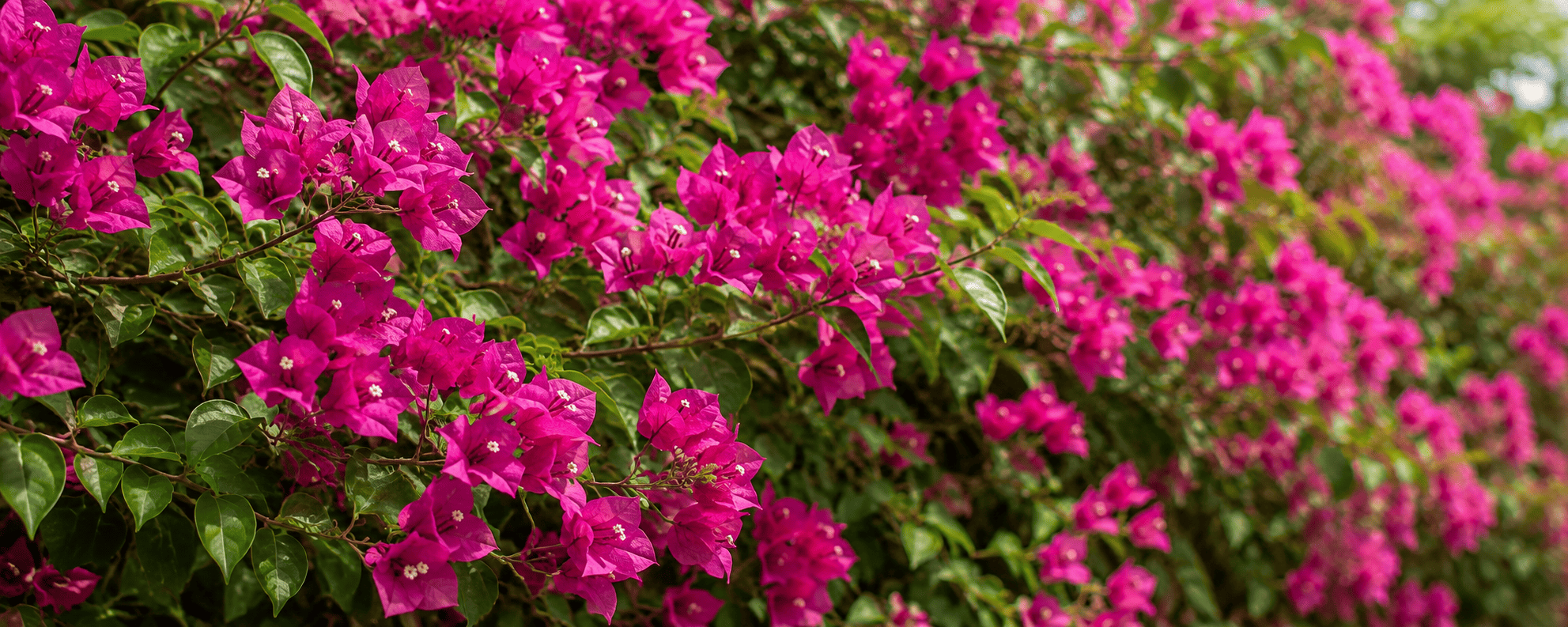
Family: Nyctaginaceae (Four O'Clock Family) Lifespan: Perennial (Woody Vine)

Bougainvillea

Bougainvillea spectabilis
🌸 Iconic Bracts ☀️ Sun Enthusiast ⚠️ Thorney Perennial

History & Linnaean Nomenclature
Bougainvillea was named after the French explorer Louis Antoine de Bougainville, who first encountered the plant in Brazil in 1768. The botanical classification is largely attributed to the French botanist Philibert Commerçon, who accompanied Bougainville on his voyage. The genus Bougainvillea belongs to the family Nyctaginaceae. What are often mistaken for petals—the vibrant, papery, colorful elements of the plant—are technically modified leaves called bracts. The actual flowers are the small, inconspicuous white or cream-colored structures nestled in the center of these bracts.

Botanical Culture & Distribution
Native to the tropical regions of South America (from Brazil to Peru and south to Argentina), these woody, perennial vines have become iconic fixtures in Mediterranean, Middle Eastern, and South Asian landscapes. They are exceptionally drought-tolerant and thrive in intense sunlight, which triggers their explosive blooming cycles. In horticulture, they are cherished for their ability to cover walls, trellises, and fences in a sea of color. While they require minimal water once established, they are notoriously sensitive to root disturbance and demand very sharp drainage to prevent decline.

Cultural & Practical Usage

Ornamental & Landscape Design

Bougainvillea is a cornerstone of tropical landscaping, prized for its explosive, vibrant color. It is ideal for covering trellises, arbors, and walls, creating spectacular floral displays. Its drought tolerance makes it a perfect choice for water-wise gardens in sunny climates.

Container & Bonsai Cultivation

Due to its woody, pliable stems, Bougainvillea is a popular subject for bonsai enthusiasts. When kept in containers and pruned regularly, it can be kept smaller and more compact, making it an excellent decorative choice for patios and balconies where space is limited.

Natural Security Barrier

The stems of Bougainvillea are lined with sharp, curved thorns that harden with age. When planted closely in a row, they form an impenetrable, beautiful, and highly effective natural security fence that deters both animals and human intruders.

Propagation Strategies

Best propagated using semi-hardwood cuttings. Successful rooting requires a sterile medium, moderate warmth, and consistent humidity. Once rooted, it is essential to minimize root disturbance during transplanting, as the plant is notoriously sensitive to such changes.

Bougainvillea Garden Display
Environmental Vine Display
  • Watering Guidelines: Drought-tolerant once established. Water thoroughly only when the soil has dried out significantly. Excessive moisture, especially during cooler dormant periods, often leads to root rot and diminished flowering.
  • Growth Conditions: Demands full, intense sun (minimum 6–8 hours daily). Thrives in poor to average, highly well-draining soil. Avoid heavy fertilizers; nitrogen-rich feeds favor leafy vine growth over the production of iconic, colorful bracts.
  • Vulnerabilities: Sensitive to cold (frost-tender) and poor soil drainage. Susceptible to aphids and spider mites if airflow is restricted. Its most challenging trait is its aggressive, thorny growth, which requires consistent, strategic pruning to manage.
  • Growth Habit: A woody, perennial vine or scrambling shrub capable of scaling walls, trellises, or fences to impressive heights.
  • Root System: A delicate, non-invasive but sensitive root system that does not tolerate disturbance; container specimens should be repotted with extreme caution.
  • Bract Structure: The showy components are actually modified leaves known as bracts. They are thin, papery, and range in color from magenta and red to orange, white, and yellow.
  • Foliage Detail: Alternate, ovate-shaped leaves that are typically a deep, rich green. Some varieties feature variegated foliage, adding interest even when the plant is not in bloom.
  • True Flowers: The actual flowers are small, inconspicuous, white or cream-colored tubular structures that emerge from the center of the larger, vibrant bracts.
  • Defense Mechanisms: The plant is well-known for its sharp, curved thorns that act as a mechanical defense and a hook for climbing, making handling difficult without protective gear.
  • Stem Characteristics: Rapidly growing, woody stems that harden and thicken as they mature, allowing the plant to support itself and its expansive canopy over architectural structures.
SAFETY: Handling & Physical Precautions

Non-Toxic but Thorny: Bougainvillea is classified as non-toxic to humans and common household pets. However, it requires careful handling due to the presence of sharp, stiff thorns along its woody stems. It is best suited for locations where it will not pose a physical hazard to children or pets.

To Humans & Children

Non-toxic upon ingestion. The primary hazard is physical injury from thorns. Always use thick gloves and eye protection when pruning. Contact with the sap can occasionally cause mild contact dermatitis in sensitive individuals.

To Household Pets

Non-toxic to cats and dogs. Ingestion of the bracts or leaves is unlikely to cause poisoning, though the sharp thorns and fibrous texture can cause significant mouth or throat irritation if chewed.

Pruning & Safety Protocol

Always wear puncture-resistant gloves and long sleeves when working with Bougainvillea. The thorns are deceptive and can easily penetrate soft fabrics. If pruning near walkways, ensure all lateral branches are cleared to prevent accidental contact.


Bougainvillea thorns detail
Mechanical Defense

Small efforts save a dying plant.

Get instant botanical diagnostics, precise care timetables, and expert structural advice tailored to support your garden's health daily.

Download PlantDecoder App Now

Frequently Asked Questions

Common botanical queries and troubleshooting instructions for Bougainvillea spectabilis.

Why is my Bougainvillea not blooming?
The most common reason for lack of blooms is insufficient sunlight; Bougainvillea requires intense, direct, full-day sun to trigger its flowering cycle. Other culprits include excessive nitrogen fertilizer, which promotes leafy growth, or too much water, which prevents the plant from entering its stress-induced flowering phase.
How do I get more bracts (color) on my plant?
Bougainvillea blooms best when slightly "stressed." Withhold water until the leaves just begin to wilt, then give it a deep, thorough watering. Additionally, ensure it is in a position to receive maximum possible sunlight and avoid over-fertilizing with nitrogen.
Why are the leaves falling off?
Leaf drop can occur due to drastic changes in environment (such as moving from outdoors to indoors), sudden temperature drops, or significant overwatering. If the plant was recently moved or repotted, it may simply be adjusting to the new conditions.
Can I grow Bougainvillea in a pot?
Yes. Bougainvillea performs exceptionally well in containers. In fact, keeping the roots slightly constrained in a pot often helps encourage more prolific blooming compared to plants grown directly in the ground. Use a very well-draining potting mix.
When is the best time to prune?
Prune immediately after a flowering cycle ends. This timing allows the plant to set new buds for the next cycle. Regular, light pruning is better than one massive cut-back, as it encourages dense growth and keeps the plant's aggressive thorns manageable.
Why are the thorns so aggressive?
The thorns are an evolutionary defensive mechanism, acting as a deterrent to herbivores and providing a "hook" for the plant to climb over other vegetation to reach sunlight. They are a permanent feature of the plant and should always be handled with thick, puncture-resistant gloves.
Do I need to fertilize my Bougainvillea?
Bougainvillea needs very little fertilizer. If you do feed it, use a low-nitrogen, balanced fertilizer during the active growing season. Too much nitrogen will lead to beautiful, lush green vines but virtually no colorful bracts.
Can it survive cold weather?
Bougainvillea is highly frost-tender and will suffer damage if temperatures drop below freezing. If you live in a climate with cold winters, the plant must be brought indoors to a bright, sun-drenched location for the winter season.
Are the leaves toxic?
No, Bougainvillea is not toxic to humans, dogs, or cats. The primary risk is not from poisoning, but from the sharp thorns, which can cause painful puncture wounds, and the sap, which can cause minor skin irritation (dermatitis) in sensitive individuals.
How often do I water a potted Bougainvillea?
Potted plants dry out faster than those in the ground. During the summer, you may need to water when the top inch of soil is dry. Always ensure the pot has ample drainage holes, as Bougainvillea will die very quickly if its roots are left sitting in stagnant water.