
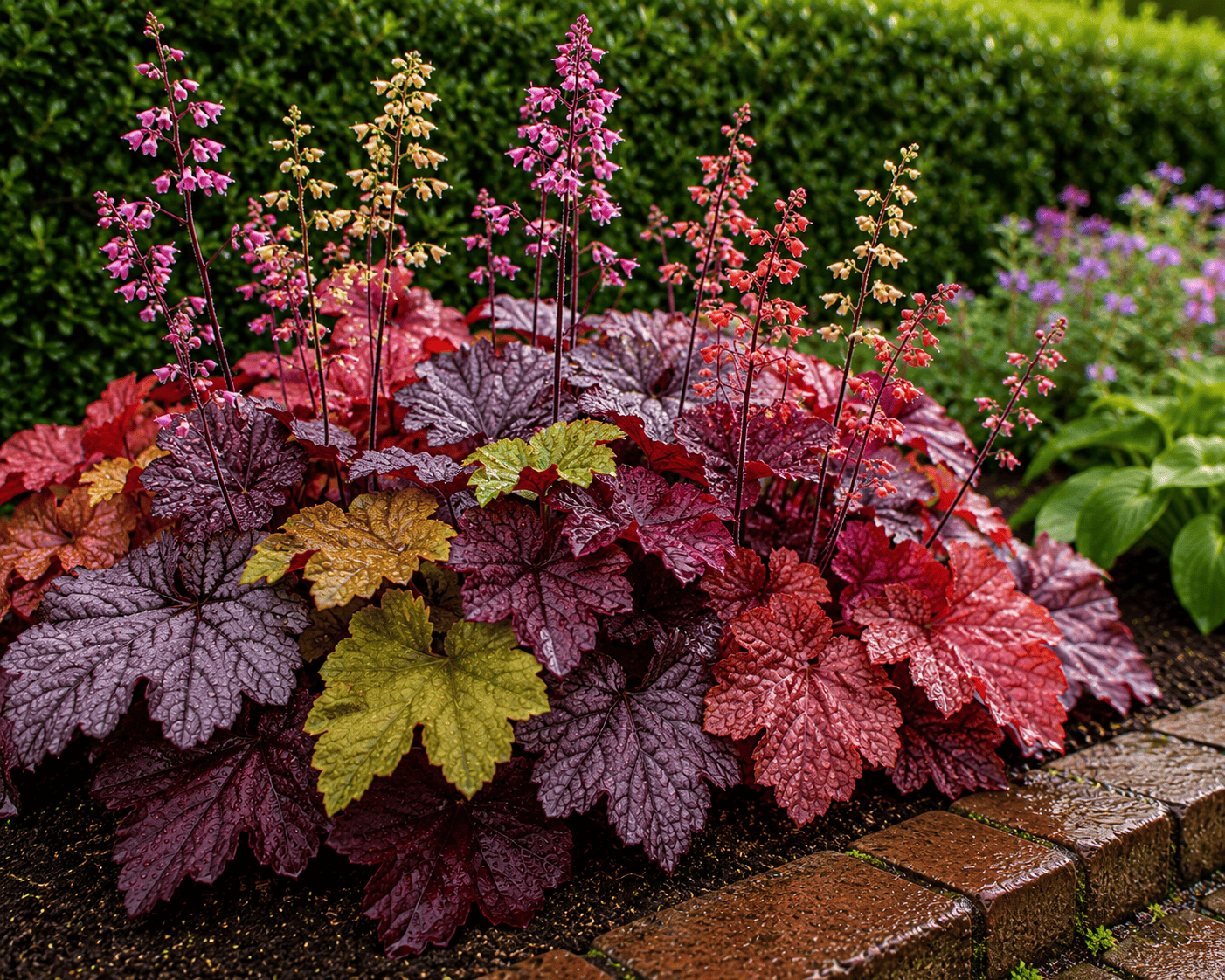
Family: Saxifragaceae Lifespan: Herbaceous Perennial

Coral Bells

Heuchera
🍁 Vibrant Foliage 🐝 Pollinator Friendly ✅ Pet-Friendly

History & Taxonomy
Native primarily to rocky woodlands and mountainous regions of North America, the genus Heuchera—commonly known as Coral Bells—belongs to the Saxifragaceae family. The genus was named in honor of Johann Heinrich von Heucher, an 18th-century German professor of botany and medicine. While early species were valued mainly for their delicate spikes of bell-shaped flowers, modern horticultural breeding has revolutionized Coral Bells into powerhouse perennials prized primarily for their breathtaking, multi-colored foliage that spans shades of amber, lime, deep purple, caramel, and silver.

Botanical Culture & Distribution
Thriving across temperate shade gardens, rockeries, and woodland borders, Coral Bells have become an absolute favorite in landscape design due to their exceptional versatility and year-round color. As hardy herbaceous perennials, they form neat, mounding rosettes of lobed leaves that remain vibrant through multiple seasons. They are widely celebrated for providing reliable color contrast in shady or partly sunny garden beds while attracting hummingbirds and beneficial pollinators with their dainty, airy flower panicles.

Cultural & Practical Usage

Garden Border & Landscaping

Coral Bells are premier landscaping perennials celebrated for their breathtaking, multi-colored foliage. They are widely used in shady garden borders, woodland gardens, mass plantings, and decorative containers to provide continuous, high-contrast color across multiple seasons.

Wildlife & Pollinator Attraction

During the spring and summer months, their slender, upright flower spikes produce delicate, bell-shaped blossoms filled with nectar. These blooms are a magnet for hummingbirds, bees, and other beneficial garden pollinators.

Ethnobotanical Heritage

Historically referred to as alumroot, indigenous North American tribes utilized the astringent properties of the tannin-rich roots. Ground root preparations were traditionally crafted into poultices and washes to help dress wounds and soothe sore throats.

Crown Division Propagation

Most successfully propagated through crown division every 3 to 4 years during early spring or fall. Separating the woody root clumps ensures vigorous new growth and prevents the center of the plant from becoming woody and sparse.

Coral Bells Garden Display
Coral Bells Foliage Display
  • Watering Guidelines: Keep soil evenly moist but well-drained, especially during the first growing season. Once established, Coral Bells tolerate brief dry spells, but consistent moisture prevents leaf scorch and promotes vibrant foliage. Avoid waterlogged soils.
  • Growth Conditions: Thrives in partial shade to full sun depending on leaf color. Lighter lime or amber cultivars require protection from harsh afternoon sun to prevent burning, while darker purple varieties handle more direct light. Prefers rich, humus-heavy, well-draining soil.
  • Vulnerabilities: Susceptible to root rot in poorly draining winter soils. Prone to frost heaving in colder climates where freezing and thawing pushes the woody crown out of the ground. Pests include vine weevils and foliar nematodes.
  • Growth Habit: Low-growing, mounding herbaceous perennial forming dense, rounded rosettes that spread gracefully outward over time.
  • Root System: Woody, fibrous rootstocks (crowns) that tend to grow upward and elevate above the soil line over several years, requiring periodic division or re-setting.
  • Leaf Structure: Rounded to heart-shaped (cordate) leaves featuring distinct lobed and scalloped margins, often with prominent veining.
  • Foliage Detail: Renowned for an extraordinary color palette spanning deep purples, limes, caramels, coppers, ambers, and silvers, often with contrasting undersides.
  • Bloom Lifespan: Long-lasting summer bloom period. Delicate bell-shaped flowers persist for weeks on airy stems, attracting hummingbirds throughout the season.
  • Floral Morphology: Tiny, bell-shaped individual flowers arranged in loose, slender, upright panicles on wiry stems rising above the foliage mound.
  • Stem Characteristics: Slender, leafless flower scapes (scapes) emerge directly from the basal root crown, often covered in soft glandular hairs.
SAFETY: Non-Toxic Profile & Handling

Completely Safe & Pet-Friendly: Coral Bells (Heuchera) are entirely non-toxic. They pose no chemical or physical hazards to humans or animals, making them an ideal, worry-free choice for family gardens and landscapes.

To Humans & Children

Completely safe upon contact or accidental ingestion. Their soft, scalloped foliage and delicate stems present no toxicity or sharp puncture hazards.

To Household Pets

Classified as non-toxic to cats, dogs, and horses by the ASPCA. While chemically safe, ingestion of large amounts of any unfamiliar fibrous plant material may cause mild, temporary stomach upset in pets.

Garden Safety & Maintenance

No special protective gear or gloves are required when planting, dividing, or pruning Coral Bells. Enjoy cultivating these colorful perennials freely throughout your garden borders and beds.


Coral Bells garden display
Pet-Friendly Perennial

Small efforts save a dying plant.

Get instant botanical diagnostics, precise care timetables, and expert structural advice tailored to support your garden's health daily.

Download PlantDecoder App Now

Frequently Asked Questions

Common botanical queries and troubleshooting instructions for Coral Bells (Heuchera).

Why are the leaves on my Coral Bells turning brown or scorching?
Leaf scorch is typically caused by too much direct afternoon sun (especially for lighter lime or amber cultivars) or inconsistent moisture. Ensure they receive partial shade during the hottest part of the day and keep soil evenly moist.
Why are the centers of my Coral Bells dying out or lifting up?
Over time, the woody root crowns naturally grow upward, causing the center to become sparse. This is easily fixed by lifting, dividing, and replanting the clumps in early spring or fall every 3 to 4 years.
How often should I water my Coral Bells?
Water deeply whenever the top inch of soil feels dry. While established plants tolerate brief dry spells, they thrive best with consistent, even moisture and organic mulch to keep their shallow root systems cool.
Why are my Coral Bells pulling out of the ground in winter?
This phenomenon is known as frost heaving, caused by alternating freeze-thaw cycles pushing shallow root crowns upward. Applying a layer of winter mulch around the base helps insulate the soil and protect the roots.
Are Coral Bells safe for pets and children?
Yes! Coral Bells (Heuchera) are completely non-toxic to cats, dogs, and humans according to the ASPCA. They contain no harmful chemicals or irritants, making them a safe choice for family gardens.
Do Coral Bells prefer sun or shade?
It depends on the foliage color! Darker purple or bronze varieties can handle more sun, while lighter lime, gold, and amber varieties require dappled shade or morning sun to prevent leaf burn.
Should I cut off the flower spikes?
While the dainty, bell-shaped flower spikes attract hummingbirds, you can snip them off at the base once blooms fade to redirect the plant's energy back into producing lush, vibrant foliage.
What pests or diseases affect Coral Bells?
They can occasionally be troubled by vine weevil larvae eating the roots or root rot caused by soggy, poorly draining winter soil. Ensuring excellent drainage is key to preventing most issues.
Are Coral Bells evergreen?
In milder climates, Coral Bells retain their vibrant foliage year-round as semi-evergreen perennials. In colder winter regions, some foliage may die back or look weathered, making way for fresh new growth in spring.
How do I propagate Coral Bells?
Propagation is best achieved through crown division in spring or early autumn. Simply dig up a mature clump, gently pull or cut apart sections containing healthy roots and shoots, and replant them immediately.