
Family: Araceae (Arum Family) Lifespan: Perennial (10+ Years)

Money Plant

Epipremnum aureum
🌿 Trailing Vine 🌬️ Air Purifying ⚠️ Mildly Toxic

History & Linnaean Nomenclature
Originally collected from Mo'orea in the Society Islands, this resilient vine has undergone several taxonomic revisions since its discovery in 1880, moving from Pothos to Rhaphidophora before definitively settling in the genus Epipremnum. Belonging to the arum family (Araceae), it is characterized by its hardy trailing vines, aerial roots, and waxy, heart-shaped foliage. Today, it is globally celebrated as one of the most popular and indestructible indoor houseplants, famously recognized for its ability to filter airborne toxins.

Botanical Culture & Distribution
While endemic to French Polynesia, Epipremnum aureum has extensively naturalized in tropical and subtropical forests worldwide. In domestic settings, it holds deep cultural significance—particularly in South Asian traditions and Feng Shui practices—where it is widely cultivated indoors as a "Money Plant," believed to attract wealth, prosperity, and positive energy. In wild, frost-free environments, however, its aggressive climbing nature allows it to overtake forest canopies, making it a potent invasive species in some tropical regions.

Cultural & Practical Usage

Ornamental & Landscape Usage

Utilized extensively as a trailing indoor houseplant, draped from hanging baskets, or trained vertically up moss poles. In frost-free tropical climates, it serves as a vigorous groundcover or climbing vine.

Air Purification Profile

Highly regarded for its phytoremediation capabilities. It was famously featured in the NASA Clean Air Study for its ability to actively filter volatile organic compounds (VOCs) like formaldehyde, xylene, and benzene from indoor environments.

Spiritual & Cultural Usage

Deeply rooted in Feng Shui and Vastu Shastra traditions. It is frequently placed in the southeast corners of homes and businesses to symbolically attract wealth, prosperity, and positive energy.

Propagation Methods

Exceptionally easy to propagate via single-node stem cuttings. Cuttings root rapidly when placed directly in water or moist potting soil, making it one of the most beginner-friendly plants to multiply.

Money Plant Trailing Indoor Display
Environmental Trailing Display
  • Watering Guidelines: Highly drought-tolerant. Allow the top 50% of the soil to dry out entirely between waterings. Overwatering is the most common cause of decline; leaves will droop when thirsty and yellow when excessively wet.
  • Growth Conditions: Highly adaptable. Thrives in bright, indirect light but will tolerate extremely low-light areas (though variegation may fade). Prefers standard well-draining aroid potting mixes and average household humidity.
  • Vulnerabilities: Extremely susceptible to root rot if left sitting in stagnant water. Pests are relatively uncommon but can occasionally include mealybugs, spider mites, or fungus gnats in constantly damp soil.
  • Growth Habit: Fast-growing, evergreen creeping vine that will trail downwards from hanging planters or aggressively climb upward if provided structural support.
  • Root System: Develops prominent aerial roots at the stem nodes, allowing the plant to anchor onto tree bark, moss poles, or walls.
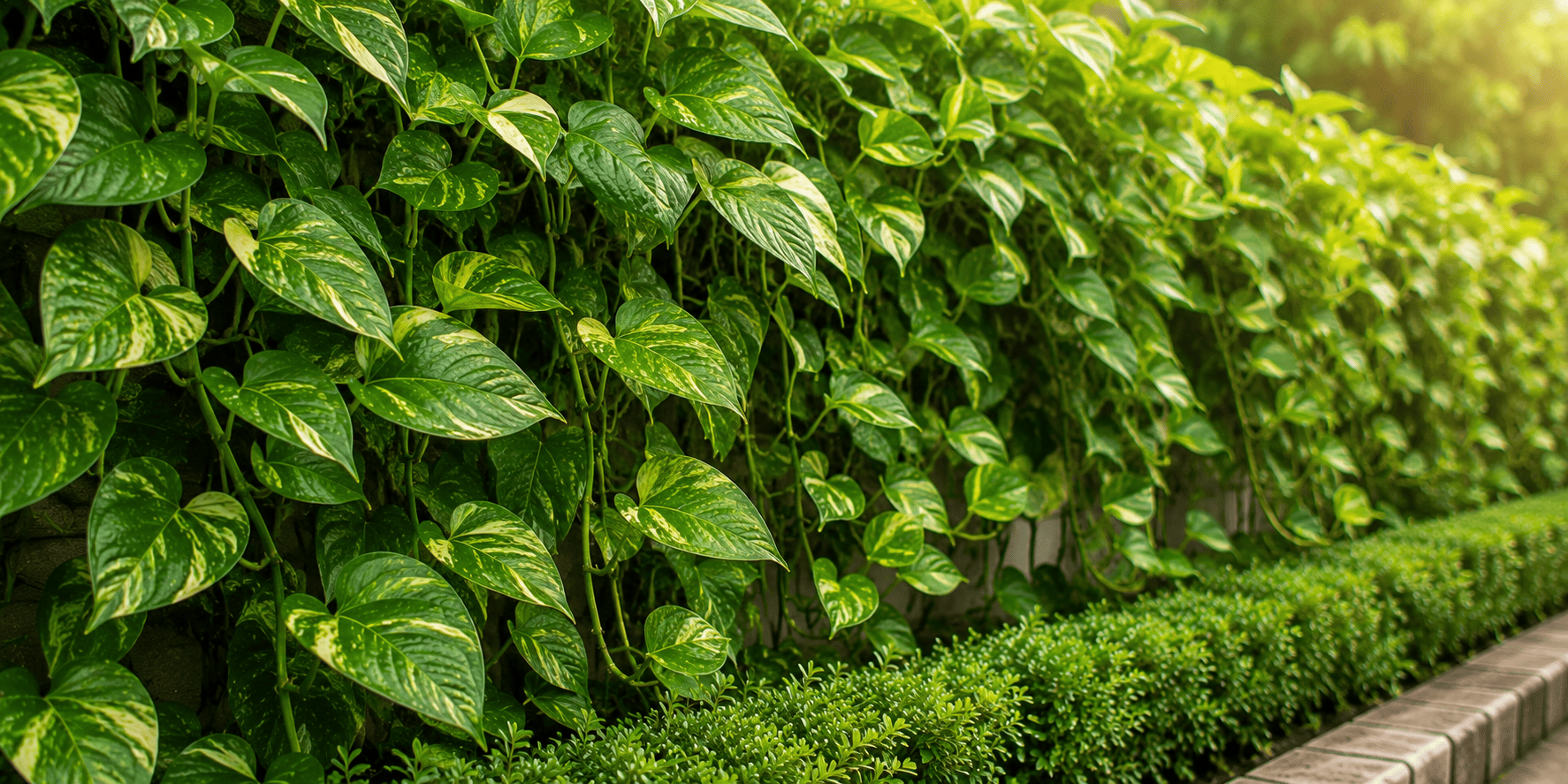
  • Leaf Structure: Alternate, deeply heart-shaped (cordate) leaves featuring a smooth, waxy surface texture.
  • Foliage Detail: Leaves are typically a vibrant, glossy green heavily splashed, marbled, or streaked with golden-yellow, pale green, or white variegation.
  • Dimorphic Growth (Juvenile vs. Mature): When trailing indoors, leaves remain in their small, juvenile form (5-10 cm). When climbing outdoors in tropical climates, mature leaves can grow up to 90 cm long and develop deep fenestrations (splits).
  • Floral Morphology: Exceptionally rare to bloom in cultivation or indoors. Mature plants in the wild produce a typical aroid inflorescence consisting of a spadix shielded by a pale spathe.
  • Stem Characteristics: Stems are fleshy, flexible, and light green, capable of rapid adventitious rooting whenever a node makes contact with water or moist substrate.
CRITICAL: Toxicity Profile & Safe Handling

Strictly Non-Edible: All vegetative components of the Money Plant contain insoluble calcium oxalate crystals (raphides). When chewed or crushed, the plant cells rupture and fire these microscopic, needle-like structures into the soft tissues of the mouth, throat, and gastrointestinal tract, causing immediate physical micro-trauma and severe irritation.

To Humans & Infants

Toxic upon ingestion. Causes immediate, intense burning and irritation of the lips, mouth, and tongue. Can lead to excessive drooling, localized swelling, and difficulty swallowing (dysphagia). Symptoms are rarely fatal but highly distressing to infants.

To Household Pets

In cats and dogs, ingestion causes severe oral irritation, aggressive pawing at the mouth, heavy drooling (hypersalivation), vomiting, and decreased appetite. It can cause localized swelling of the upper airway in rare, severe cases.

Avoidance & Protection Strategies

Utilize hanging baskets, macrame hangers, or place pots on elevated shelves to keep trailing vines safely out of reach of curious pets and toddlers. Wash your hands or wear gloves after pruning, as the sap may cause mild contact dermatitis in sensitive skin.


Hanging Pothos display keeping vines out of reach
Safe Hanging Display

Small efforts save a dying plant.

Get instant botanical diagnostics, precise care timetables, and expert structural advice tailored to support your garden's health daily.

Download PlantDecoder App Now

Frequently Asked Questions

Common botanical queries and troubleshooting instructions for Epipremnum aureum.

Why are my Money Plant leaves turning yellow?
Widespread yellowing of the leaves is almost exclusively caused by overwatering or poor soil drainage. If roots sit in stagnant water, they suffocate and rot. Ensure the top 50% of the soil is completely dry before watering again, and always use pots with drainage holes.
Does a Money Plant actually purify indoor air?
Yes, it is highly effective at phytoremediation. The NASA Clean Air Study famously documented its ability to actively filter and remove harmful volatile organic compounds (VOCs)—such as formaldehyde, benzene, and xylene—from enclosed indoor environments.
Can a Money Plant live purely in water?
Yes. They adapt incredibly well to hydroponic growing. A cutting placed in a jar of water will root and continue to grow indefinitely. Just remember to change the water every couple of weeks and add a drop of liquid fertilizer occasionally to provide essential nutrients.
Why is my Money Plant losing its golden variegation?
When leaves revert to a solid, flat green color, it is almost always a sign of insufficient lighting. The plant increases its green chlorophyll to survive in low light. Move it to a brighter spot with indirect sunlight, and new growth should emerge with marbling again.
Can I grow a Money Plant outdoors?
Yes, but strictly in warm, tropical, frost-free climates (USDA Zones 10–12). In colder regions, it must be grown in containers and brought indoors before temperatures drop, as frost and freezing conditions will quickly destroy the fleshy vines.
How often should I water my indoor Money Plant?
As a general rule, water every 1 to 2 weeks. Allow the soil to dry out significantly between cycles. When you do water, soak it thoroughly until water runs out the bottom. If the leaves begin to look droopy and wilted, it's usually time for a drink.
Does the Money Plant prefer sun or shade?
It thrives best in bright, indirect light. It can tolerate quite low light conditions (making it great for offices), but growth will slow. Avoid harsh, direct afternoon sunlight, which can easily scorch and burn the delicate foliage.
What are the most common pests that attack this plant?
While generally pest-resistant, stressed indoor plants can sometimes attract mealybugs, spider mites, or fungus gnats (gnats usually appear if the soil is kept too wet). Treat infestations early by wiping leaves with insecticidal soap, diluted neem oil, or rubbing alcohol.
Is the Money Plant toxic to pets or children?
Yes. All parts of the plant contain insoluble calcium oxalate crystals. If chewed or swallowed, these microscopic needles cause immediate and severe irritation, swelling, drooling, and vomiting in dogs, cats, and humans. Always keep the plant out of reach.
When is the best time to prune or propagate my plant?
While you can trim an indoor houseplant year-round, the active growing seasons of spring and summer are best. To propagate, simply snip a vine just below a root node (the little brown bumps on the stem) and place it directly into water or moist soil.