
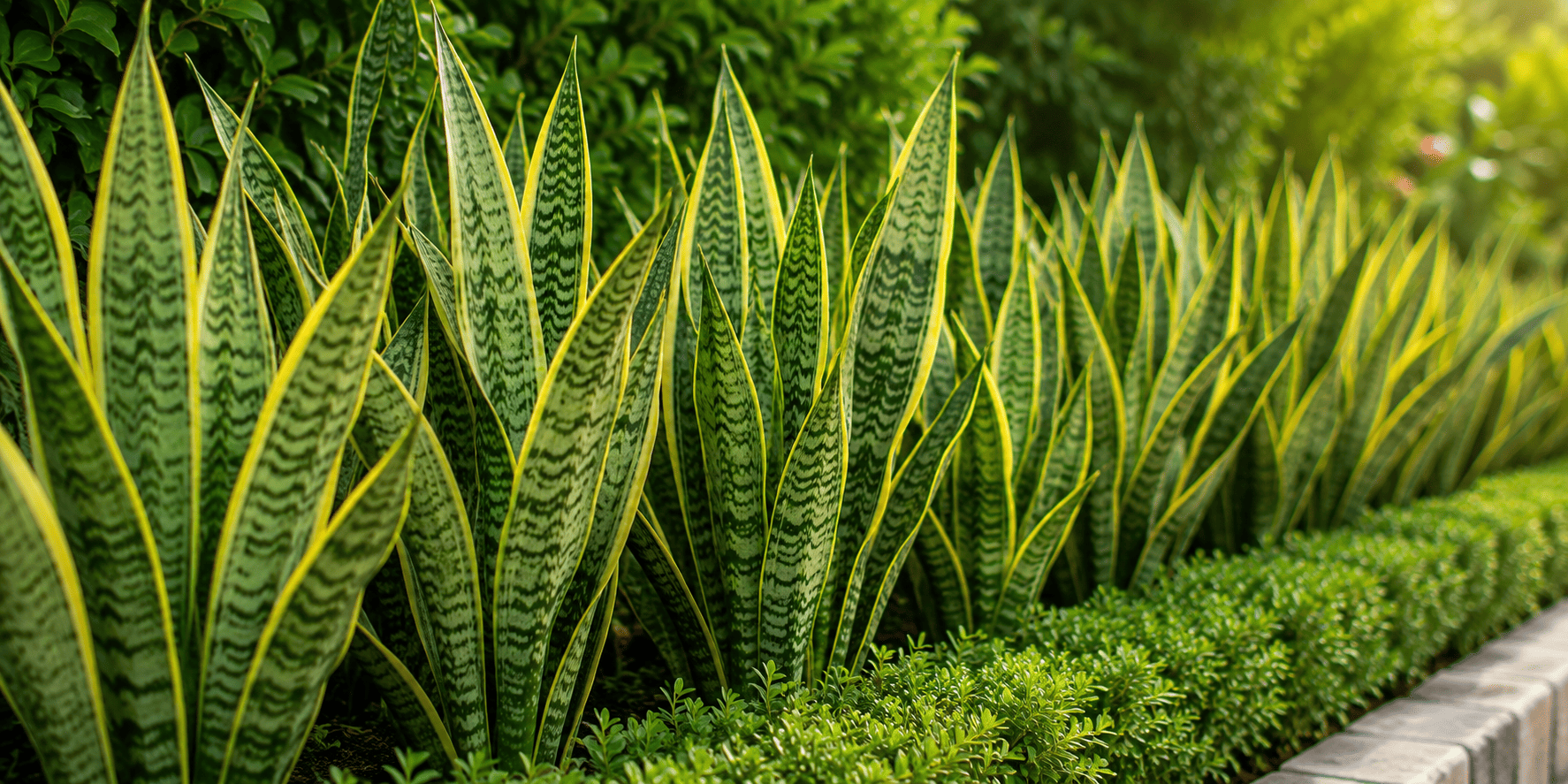
Family: Asparagaceae (Asparagus Family) Lifespan: Perennial (10-25+ Years)

Snake Plant

Sansevieria trifasciata (syn. Dracaena)
🌿 Succulent Foliage 🌬️ Air Purifying ⚠️ Mildly Toxic

History & Linnaean Nomenclature
Historically classified under the genus Sansevieria—named in honor of Pietro Antonio Sanseverino, an 18th-century Italian patron of botany—this iconic succulent has recently been reclassified into the genus Dracaena based on modern molecular phylogenetic studies. Belonging to the asparagus family (Asparagaceae), it is globally recognized for its stiff, upright, sword-like foliage and strong architectural form. It has earned a reputation as a nearly indestructible houseplant, championed for both its aesthetic appeal and extreme resilience in sub-optimal indoor conditions.

Botanical Culture & Distribution
Native to the rocky, arid habitats of tropical West Africa—spanning from Nigeria to the Congo—this plant has evolved to withstand intense heat and prolonged drought. Beyond its biological endurance, it holds significant cultural value; in Chinese tradition, it is often placed near entrances to attract the Eight Gods' Virtues (including prosperity, health, and long life). Historically, its strong plant fibers were extracted to make durable bowstrings, earning it the name "Viper's Bowstring Hemp." Today, it is highly celebrated for its air-purifying qualities, uniquely utilizing CAM (Crassulacean Acid Metabolism) photosynthesis to release oxygen continuously throughout the night.

Cultural & Practical Usage

Ornamental & Landscape Usage

Extensively utilized as an architectural focal point in modern interior design, office spaces, and commercial lobbies. In warm, frost-free climates, it is frequently mass-planted as a striking, drought-tolerant border or structural groundcover.

Air Purification Profile

Renowned for its exceptional air-filtering capabilities. It utilizes Crassulacean Acid Metabolism (CAM) to absorb carbon dioxide and release oxygen continuously throughout the night, making it an ideal bedroom companion. It actively filters toxins like formaldehyde, xylene, and toluene.

Spiritual & Cultural Usage

Deeply symbolic in several cultures. In Chinese Feng Shui, placing a Snake Plant near entrances is believed to draw in the Eight Gods' Virtues—including prosperity, beauty, long life, and health. In parts of Africa, it is traditionally associated with Ogun, the deity of war, and is used in spiritual protection rituals.

Propagation Methods

Incredibly simple to multiply. The most reliable method is root division, separating the thick underground rhizomes during repotting. It can also be propagated via leaf cuttings placed in water or soil, though cuttings from variegated varieties typically revert to a solid green color.

Snake Plant Indoor Display
Environmental Indoor Display
  • Watering Guidelines: Highly drought-tolerant succulent. Requires infrequent watering. Allow the potting medium to dry out completely—often taking 2 to 4 weeks—before deeply soaking the soil again.
  • Growth Conditions: Famously adaptable. Thrives optimally in bright, indirect sunlight but will easily tolerate extremely low-light areas. Requires a highly porous, fast-draining substrate like a standard cactus or succulent mix.
  • Vulnerabilities: Extremely susceptible to root rot if overwatered or if pots lack drainage holes. While mostly pest-free, compromised plants can occasionally suffer from mealybugs or spider mites. Avoid exposing the plant to temperatures below 10°C (50°F).
  • Growth Habit: Stemless evergreen perennial that forms stiff, upright, clumping rosettes, presenting a strong architectural and vertical profile.
  • Root System: Features thick, robust underground rhizomes that spread laterally. These rhizomes are so vigorous they can occasionally deform or crack thin plastic nursery pots as they multiply.
  • Leaf Structure: Erect, fleshy, sword-shaped leaves that taper to a sharp, stiff point. The foliage is incredibly tough, fibrous, and capable of storing significant water reserves.
  • Foliage Detail: Leaves are typically dark green, heavily marbled with striking light green or gray-green horizontal cross-banding. Many popular cultivars feature distinct, vibrant yellow margins.
  • Floral Morphology: Blooming is rare in indoor cultivation. When environmentally stressed or root-bound, mature plants may produce a tall raceme (flower spike) densely packed with clusters of small, highly fragrant, greenish-white tubular flowers.
  • Metabolic Profile: Utilizes Crassulacean Acid Metabolism (CAM) photosynthesis, allowing the plant to keep its stomata closed during the hot day to conserve water, and open them at night to actively absorb carbon dioxide.
CRITICAL: Toxicity Profile & Safe Handling

Strictly Non-Edible: The rigid foliage of the Snake Plant contains saponins, which are natural chemical compounds the plant utilizes as a defense mechanism against insects and fungi. When ingested by mammals, these saponins cause mild to moderate gastrointestinal distress and irritation.

To Humans & Infants

Mildly toxic upon ingestion. Symptoms are generally not severe but can include excessive drooling, nausea, vomiting, and diarrhea. The tough, fibrous nature of the leaves also presents a physical choking hazard for small children.

To Household Pets

Toxic to both cats and dogs according to the ASPCA. Ingestion typically leads to excessive salivation, lethargy, nausea, vomiting, and diarrhea. Cats in particular may also exhibit signs of dilated pupils.

Avoidance & Protection Strategies

While the stiff, upright leaves are generally less tempting for pets to chew on than soft-trailing vines, it is still best to place pots on elevated plant stands or enclosed within borders if you have pets prone to grazing on houseplants.


Snake plant elevated on a safe wooden stand
Elevated Safety Display

Small efforts save a dying plant.

Get instant botanical diagnostics, precise care timetables, and expert structural advice tailored to support your garden's health daily.

Download PlantDecoder App Now

Frequently Asked Questions

Common botanical queries and troubleshooting instructions for Sansevieria trifasciata.

Why are my Snake Plant leaves turning yellow and mushy?
Widespread yellowing and a soft, mushy texture at the base are almost exclusively caused by overwatering and root rot. Ensure the potting medium dries out completely between watering cycles and that the pot has adequate drainage holes.
How often should I water my Snake Plant?
As a drought-tolerant succulent, it requires very infrequent watering. During the active growing seasons, water deeply only every 2 to 4 weeks. During the winter dormancy period, reduce watering to once every month or two.
Does the Snake Plant need direct sunlight?
No. While it thrives optimally in bright, indirect sunlight, it is famous for its extreme adaptability and will easily tolerate low-light conditions, making it an excellent choice for windowless offices or dark corners.
Why are the leaves on my Snake Plant falling over?
Leaves that droop or bend over abruptly usually indicate overwatering, insufficient light, or a lack of structural support in overly loose soil. Move the plant to a brighter location and allow the soil to dry thoroughly.
Is the Snake Plant toxic to cats and dogs?
Yes. It contains saponins, making it mildly toxic to household pets. If chewed or ingested, it can cause excessive drooling, nausea, vomiting, and gastrointestinal distress. Keep it elevated or out of reach of curious pets.
Does the Snake Plant really purify indoor air?
Yes. It utilizes Crassulacean Acid Metabolism (CAM) photosynthesis, allowing it to absorb carbon dioxide and continuously release oxygen at night. It is also proven to filter out harmful volatile organic compounds (VOCs) like formaldehyde and benzene.
Can I propagate a Snake Plant from a leaf cutting?
Yes, you can easily propagate them by placing cut leaf sections directly into water or moist soil. However, note that leaf cuttings taken from variegated varieties (with yellow edges) will typically revert to growing as solid green plants.
How fast do Snake Plants grow?
They are generally slow-growing plants, particularly when kept in low-light indoor environments. Growth will accelerate slightly during the warm spring and summer months if provided with bright, indirect light and a dilute fertilizer.
When should I repot my Snake Plant?
They prefer to be somewhat root-bound and generally only require repotting every 3 to 5 years. You should only repot in the spring when the thick underground rhizomes begin to deform, crack, or completely outgrow the current container.
Why are the tips of my Snake Plant leaves turning brown?
Brown, crispy tips are usually the result of inconsistent watering, extreme underwatering, or physical trauma (getting bumped or bruised). Once a tip is damaged, it will not heal, and that specific leaf will stop growing taller.