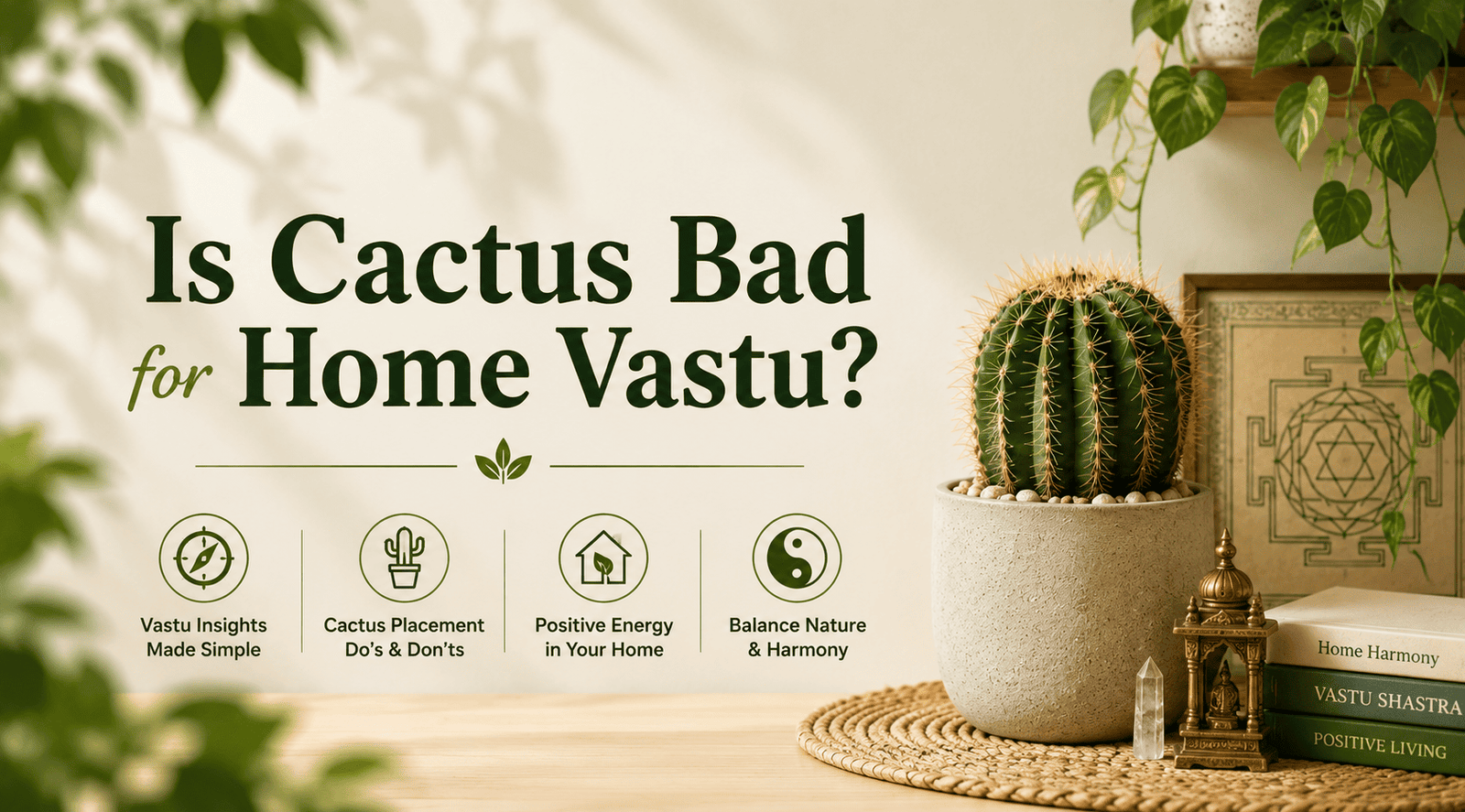
Is Cactus Bad for Home Vastu? The Truth Nobody Tells You
By PlantDecoder | Vastu & Feng Shui
A few years ago, a woman in my apartment building spent three months building what she called her "desert corner."
A south-facing balcony, beautiful terracotta pots, a collection of about fifteen cacti in various sizes — golden barrel, column cactus, a few small echeverias, one spectacular organ pipe that had taken years to grow to its current height. She'd arranged them with genuine care. It looked like something out of an architectural magazine.
Then her mother-in-law visited.
"These need to go," the mother-in-law said, before she'd even put down her handbag. "Cactus in the home brings arguments. Everybody knows this."
The woman came to knock on my door that evening, slightly shell-shocked, asking if it was true.
It's a question I've heard more variations of than almost any other plant question. And the answer is genuinely more nuanced than "yes, cactus is bad" or "no, that's superstition" — both of which oversimplify something that's actually worth understanding properly.
What Vastu Shastra Actually Says About Cactus
Let's go to the source before we go anywhere else.
Traditional Vastu Shastra texts don't single out the cactus specifically — cactus is a New World plant, and the ancient Indian texts predate its introduction to the subcontinent by centuries. What Vastu does address, clearly and consistently, is a category of plants: thorny plants indoors.
The principle is this: plants with thorns, spines, or sharp protrusions generate what Vastu calls sha energy — energy that is pointed, cutting, and confrontational rather than soft, flowing, and welcoming. This applies to roses, to acacia, to euphorbia, and yes, to cactus.
The concern isn't about the plant's beauty or its drought-tolerance. It's about the energetic quality of sharp things in a living space. A home is meant to be a place of softness, of welcome, of rest. Thorns are the opposite of that.
So is cactus bad for Vastu?
Indoors: yes, according to traditional Vastu principles. In the main living spaces of a home — bedroom, living room, entrance — cactus and other thorny plants are specifically discouraged.
But here's what the mother-in-law missed: the outdoor balcony is a different story.
The Indoor/Outdoor Distinction That Changes Everything
This is the nuance that gets lost in the simplified version of "cactus is bad."
Vastu's concern about thorny plants is specifically about indoor placement. The energy principles that apply to the interior of a home — where family sleeps, eats, gathers, rests — don't apply in the same way to a balcony, terrace, or garden.
A cactus collection on an outdoor balcony, particularly one that doesn't face the main entrance or the bedroom window, is a very different Vastu situation from a cactus on the living room windowsill or the entrance hall shelf.
The woman with the desert balcony wasn't necessarily doing something Vastu-incompatible. The question is which direction her balcony faces and whether the cacti were visible from inside the home as a primary feature of her living space.
South or west-facing balcony
This is where thorny, resilient, yang-energy plants like cactus are most compatible in Vastu. The south and west are associated with more active, structured energy — which cactus, with its self-sufficiency and sharp defences, aligns with better than the gentle north or east.
North or northeast facing
Cactus here is more problematic even outdoors, as these directions are associated with prosperity, spirituality, and gentle incoming energy.
So: outdoor cacti on a south or west-facing terrace = acceptable. Indoor cacti anywhere in the main living spaces = not recommended in traditional Vastu.
The Arguments and Relationship Belief: Where Does It Come From?
The specific belief that cactus causes arguments in the home is widespread — you'll hear it across India, but also in Chinese feng shui traditions and in various folk beliefs across cultures.
In feng shui, the mechanism is similar: sharp, pointed plants create "sha chi" — cutting energy — that disrupts the soft flow of qi through a home. This cutting energy is associated with friction, tension, and conflict.
The Vastu version connects to the idea that the home's energy mirrors its inhabitants' experience. A home full of soft curves, flowing plants, and gentle textures supports harmonious relationships. A home with sharp, pointed elements — thorns, angular furniture, broken things — creates an environment that subtly reinforces tension.
Environmental Psychology Perspective
Is there controlled scientific evidence for this? No.
Is there a real observed correlation between people's environment and their psychological state? Absolutely yes — environmental psychology is a robust field, and it consistently shows that the texture, colour, and feel of a space affects mood, stress levels, and interpersonal behaviour.
Whether you attribute the effect to Vastu energy principles or to environmental psychology, the practical recommendation is the same: softer living spaces tend to support better relationships.
What to Do If You Love Cacti
If you're someone who genuinely loves cacti — their architectural beauty, their extraordinary diversity, their defiant self-sufficiency — you don't have to rehome your collection. You just need to place it thoughtfully.
Outdoor placement
Move outdoor collections to south or west-facing areas. This is the most Vastu-compatible position for thorny plants.
Keep out of the bedroom
Keep cacti out of the bedroom entirely. This is the clearest and most consistent Vastu recommendation. The bedroom is for rest and intimacy — the sharp energy of cactus is particularly incompatible with these qualities.
Avoid main entrance
Keep cacti away from the main entrance. The entrance is where the home's energy is invited in. Thorny plants at the entrance are specifically problematic.
Indoor study or home office
For indoor lovers: A south-facing windowsill in a home office or study is the most defensible indoor position. The work environment, associated with discipline and focus, is more compatible with cactus energy than the rest spaces of the home.
The euphorbia distinction
Many plants sold as "cactus" in Indian nurseries are actually euphorbias — they look like cacti but have milky white sap that is a serious skin and eye irritant. The Vastu concerns about thorns apply here too, plus a practical safety concern. Always identify what you're buying.
Feng Shui Says the Same Thing (Mostly)
For the feng shui followers reading this: the guidance aligns closely with Vastu on this topic.
Sharp, pointed plants — including cactus — are discouraged in feng shui for interior spaces, particularly bedrooms and family areas.
The southeast wealth corner especially should have round-leafed, soft plants (jade plant, pothos, money tree) rather than sharp ones.
The one place feng shui is more permissive about cacti than Vastu is the home office or workspace — where the disciplined, defended energy of a cactus is sometimes considered appropriate.
Plants to Use Instead of Indoor Cactus
If you're reconsidering your indoor cactus after reading this, here are the best replacements — plants that give you structural drama and low-maintenance care without the sharp energy:
Areca Palm
Architectural, dramatic, absolutely no thorns. One of the best low-maintenance statement plants available.
ZZ Plant
Glossy, structured, indestructible. Provides the "I don't need much from you" energy of a cactus without the spines.
Snake Plant
Tall, architectural, drought-tolerant — literally the closest non-thorny plant to a cactus in terms of care requirements. And it's fine for indoor Vastu placement.
Jade Plant
Round-leafed, structured, associated with prosperity in both Vastu and feng shui. The spiritual opposite of cactus in the best possible way.
Quick Answers: Cactus and Vastu
Direct answers to common questions about cactus, Vastu placement, and home energy:
Is cactus bad for home according to Vastu?
Can I keep cactus on my balcony as per Vastu?
Does cactus cause fights at home?
Where should I put cactus if I want to keep it indoors?
What plant can replace cactus indoors for a similar look?
Harmonize Your Home with PlantDecoder
Instantly scan any houseplant to verify botanical species, toxicity profiles, and Vastu compatibility for every room in your home.
The Verdict
The mother-in-law wasn't entirely wrong — but she wasn't entirely right either.
Cactus indoors, especially in living and sleeping spaces, does conflict with traditional Vastu principles around soft, welcoming energy. That's real, and it's worth taking seriously if Vastu matters to your household.
But a beautifully curated cactus collection on a south-facing balcony, tended with care and placed thoughtfully? That's not a Vastu problem. That's a person who loves their plants and knows where to put them.
The tradition has nuance. Apply it with nuance.
Stop Guessing. and Start Rescuing.
Join over 1,000+ plant parents who have permanently eliminated watering anxiety. Access instant Gemini AI leaf diagnostics and custom environmental care systems completely free.