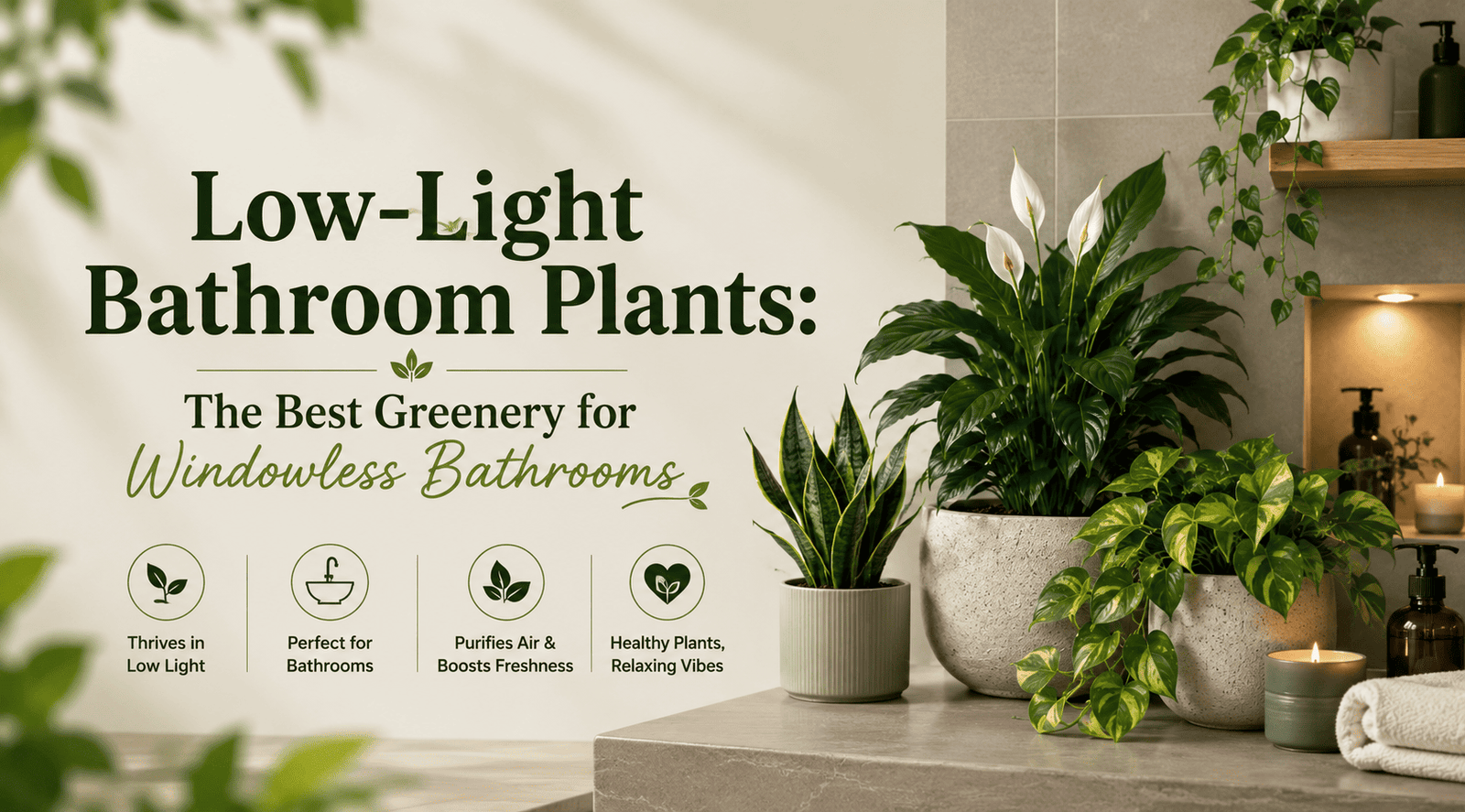
Low Light Bathroom Plants: The Best Greenery for Windowless Bathrooms
By PlantDecoder | Indoor Plants & Plant Care
I want to tell you about the worst plant purchase I ever witnessed.
A friend bought a fiddle leaf fig for her bathroom. A gorgeous, tall, dramatically leafed fiddle leaf fig — the kind that costs serious money and requires serious commitment. She put it in her bathroom because she'd seen a photo online that looked exactly like what she wanted: a sleek, dark bathroom with a towering plant in the corner, bathed in soft natural light.
Her bathroom had one frosted glass window the size of a paperback novel, facing north, partially blocked by the adjacent building.
Within six weeks, the fiddle leaf fig had dropped every single leaf. She was left with a very expensive stick in a very nice pot.
The problem wasn't that she bought a fiddle leaf fig. It wasn't even that she put it in the bathroom. The problem was that she chose a plant for how it looked in a well-lit photo rather than what her specific bathroom could actually support.
This guide is the thing that would have saved her those six weeks and that money.
The Windowless Bathroom Problem
Let's start by being honest about what "low-light bathroom" actually means in most homes.
It means a bathroom with no natural light, or with so little that any plant you've tried before has quietly given up on you within a month. It might be an interior bathroom in a flat with no external walls. It might be a guest bathroom that gets artificial light only. It might be a small bathroom where the single window is frosted, north-facing, and too small to make a real difference.
These bathrooms exist everywhere — and they are legitimately challenging for plants. Not impossible. Challenging.
Challenge 1: Energy & Light
Plants need light to photosynthesise — to do the fundamental biological work of being alive. No light means no energy.
Challenge 2: Microclimate Swings
Low-light bathrooms often also have temperature swings (cold in the morning, steamy during showers, cold again) and variable humidity, which adds another layer of complexity.
But here's what works in your favour: low-light bathrooms are often high-humidity bathrooms.
And for a specific category of plants — tropical species that evolved on the shaded floors of humid rainforests — high humidity is far more valuable than direct sunlight. These plants have adapted to filter through forest canopy, to make extraordinary use of limited light, and to thrive in conditions that would kill most plants.
You just need to find the right ones.
The Non-Negotiable: Supplement with a Grow Light
Before the plant list, the most important practical point in this entire guide:
If your bathroom has no natural light, add a small grow light.
This is not complicated. A simple LED grow bulb in an existing fixture, or a plug-in grow light on a small timer, set to run for 10-12 hours a day — this costs very little and opens up your plant options significantly.
The difference between "zero light" and "artificial grow light" is the difference between two or three plant options and twenty.
If you absolutely won't add a grow light, the list below gives you the most extreme low-light survivors. But a grow light changes the game completely, and I'd encourage you to try it before concluding that plants in your bathroom aren't possible.
The Best Plants for Low-Light and Windowless Bathrooms
Here are the top six proven houseplant species engineered by nature to survive in low-light, high-humidity bathroom environments:
1. Pothos (Epipremnum aureum)
If there is one plant that was designed — metaphorically speaking — to survive in a windowless bathroom, it's pothos.
Pothos tolerates lower light levels than virtually any other plant. It will grow under artificial light. It will grow in a bathroom with one small frosted window. It will grow in conditions that make every other plant give up and go limp. It is, genuinely, the most forgiving houseplant in existence.
In a bathroom, pothos earns an extra point for aesthetics: it trails beautifully from a high shelf, and a long, trailing pothos in a bathroom feels lush and intentional in a way that punches well above its maintenance requirements.
The catch: Pothos is mildly toxic to cats and dogs (calcium oxalate crystals). If pets have bathroom access, keep it high and out of reach or choose the spider plant instead.
Care in a low-light bathroom: Water every 10-14 days (it dries out slowly in a low-light, humid bathroom), wipe leaves monthly to keep them clean and light-absorbing.
Design note: A trailing golden pothos or marble queen pothos from a high shelf in a dark bathroom is one of the simplest, most reliable aesthetic upgrades available.
2. Snake Plant (Sansevieria / Dracaena trifasciata)
The snake plant is the other titan of low-light survival.
It tolerates near-darkness with a composure that borders on the supernatural. It needs water so infrequently (every 3-4 weeks in a low-light bathroom) that the main risk is actually overwatering. It releases oxygen at night, which is relevant in a small, enclosed space. And its upright, architectural form works beautifully in a bathroom corner.
The snake plant also has the advantage of staying exactly where you put it — it won't trail, climb, or spread. In a small bathroom where space is limited, a tall, narrow snake plant takes up minimal floor area while providing maximum visual presence.
Care in a low-light bathroom: Water rarely and let the soil dry out completely between waterings. Overwatering in a low-light environment (where the soil dries slowly) causes root rot faster than almost anything else.
Mild toxicity note: Snake plant causes mild gastrointestinal upset in cats and dogs if ingested. Keep out of reach of pets.
3. ZZ Plant (Zamioculcas zamiifolia)
The ZZ Plant is the low-light bathroom's secret weapon.
Its glossy, dark green leaves look polished and considered in a way that elevates a bathroom immediately. It grows from rhizomes (underground storage organs) that store water and nutrients, meaning it can survive extended periods of neglect — including weeks without watering.
It genuinely tolerates very low light. It tolerates irregular watering. It tolerates the temperature fluctuations of a bathroom environment. It is, in the most practical sense possible, close to indestructible.
The ZZ plant also has the advantage of looking expensive. In a simple dark pot, it looks like a conscious design decision rather than a survival plant.
Care in a low-light bathroom: Water every 3-4 weeks. Do not overwater — this is the one thing that will kill it. The rhizomes store moisture, so the plant can go much longer without water than you'd expect.
Mild toxicity: Like pothos, ZZ plant contains calcium oxalate. Wash hands after handling and keep away from pets and children.
4. Cast Iron Plant (Aspidistra elatior)
The name tells you everything you need to know.
The cast iron plant is the toughest low-light plant in existence. It was a Victorian parlour plant precisely because Victorian parlours were dark, smoky, and challenging environments — and the Aspidistra survived them all.
It has deep green, strap-like leaves that are genuinely architectural. It grows slowly (which is actually ideal for a bathroom — you're not trying to manage explosive growth). It tolerates cold, drafts, low humidity, irregular watering, and near-darkness.
It's not flashy. It won't cascade dramatically or produce striking flowers. But in a bathroom where other plants have failed, the cast iron plant will simply continue existing, and there is something deeply reassuring about that.
Care in a low-light bathroom: Water once every 2-3 weeks. Clean the leaves monthly — they collect dust in a bathroom environment and dust reduces their already-limited light absorption.
5. Lucky Bamboo (Dracaena sanderiana)
Lucky bamboo — associated with good fortune in both Chinese feng shui and modern Indian home culture — is ideal for a small, low-light bathroom for a specific reason: it grows in water.
No soil, no drainage holes required, no complicated watering schedule. A few stalks in a glass vase with decorative pebbles, kept topped up with water, can live indefinitely in a bathroom with only artificial light.
It stays small and compact. It looks clean and minimal. And in a bathroom that also serves as a quiet, private space, the feng shui associations of lucky bamboo — peace, good energy, upward growth — feel genuinely appropriate.
Care in a low-light bathroom: Change the water weekly to prevent stagnation. Keep away from direct heat sources (hairdryers, heated towel rails). Use room-temperature water rather than cold straight from the tap.
Note: Lucky bamboo is mildly toxic to cats and dogs. Keep out of reach of pets.
6. Peace Lily (Spathiphyllum)
The peace lily is one of the few flowering plants that genuinely thrives in low-light conditions — and those white, elegant blooms in a dark bathroom are genuinely beautiful.
It's also one of the most studied air-purifying plants available, removing benzene, formaldehyde, and ammonia from indoor air. In a bathroom where cleaning products are used regularly, this is a practical benefit, not just a talking point.
Peace lily will tell you clearly when it needs water: it droops dramatically and then springs back within hours of being watered. This communication is honestly helpful in a low-light bathroom where standard watering schedules don't reliably apply.
Important: Peace lily is toxic to cats and dogs, and mildly toxic to children. For a family bathroom with pet access, choose pothos, snake plant, or ZZ plant instead.
Care in a low-light bathroom: Water when it droops (or proactively before it droops). It prefers consistently moist soil. In a humid bathroom, it will need watering less frequently than elsewhere.
The Grow Light Setup: What You Actually Need
If you want to expand beyond the six plants above, here's the simplest possible grow light setup for a bathroom:
Smart LED Bulb Integration
A smart LED bulb in an existing bathroom fixture, chosen specifically for plant growing (look for full-spectrum LED bulbs in the 5000-6500K colour temperature range). Set it on a smart timer to run 10-12 hours a day. This is the lowest-friction option — no extra fixtures, no extra cables.
Clip-on Shelf Light
A clip-on grow light attached to a shelf works well for targeted plant lighting without changing your bathroom's ambient light.
What you don't need: An elaborate grow light setup.
For bathroom plants, the goal is survivable light, not optimal growing conditions. Simple and consistent beats complex and variable.
The Dark Bathroom Design Principle
A dark bathroom with one well-chosen plant in a beautiful pot looks intentional and considered.
A dark bathroom with five struggling plants in mismatched containers looks like a problem.
In low-light bathrooms especially: choose one or two plants, choose them deliberately, and invest in a good pot. The constraints of the environment actually make this easier — you can't overplant a small dark bathroom, so you're forced into the restraint that usually makes spaces look best.
A single ZZ Plant in a tall, dark matte ceramic pot.
A trailing pothos from a wooden shelf.
Lucky bamboo in a clean glass vase on the counter.
Any of these, done well, is a complete and beautiful solution.
Quick Answers: Windowless Bathroom Plant Questions
Direct answers to common questions about keeping houseplants in low-light and windowless bathrooms:
What plants can survive in a bathroom with no windows?
Can any plant live without natural light in a bathroom?
How do I keep bathroom plants alive in low light?
Is snake plant good for bathrooms?
Why do my bathroom plants keep dying?
Diagnose Your Bathroom Plants with PlantDecoder
Instantly scan any houseplant to check light requirements, soil moisture needs, and health status in seconds.
One Last Thing
My friend with the fiddle leaf fig bought a pothos after the great leaf-dropping incident of 2024. She put it on the same shelf where the fiddle leaf had stood.
It's been eighteen months. It's trailing halfway down the wall. She's had to trim it three times.
The right plant in the right place doesn't just survive. It makes you feel like you know what you're doing.
Pick the right plant. Let it prove itself. Then get another one.
Stop Guessing. and Start Rescuing.
Join over 1,000+ plant parents who have permanently eliminated watering anxiety. Access instant Gemini AI leaf diagnostics and custom environmental care systems completely free.