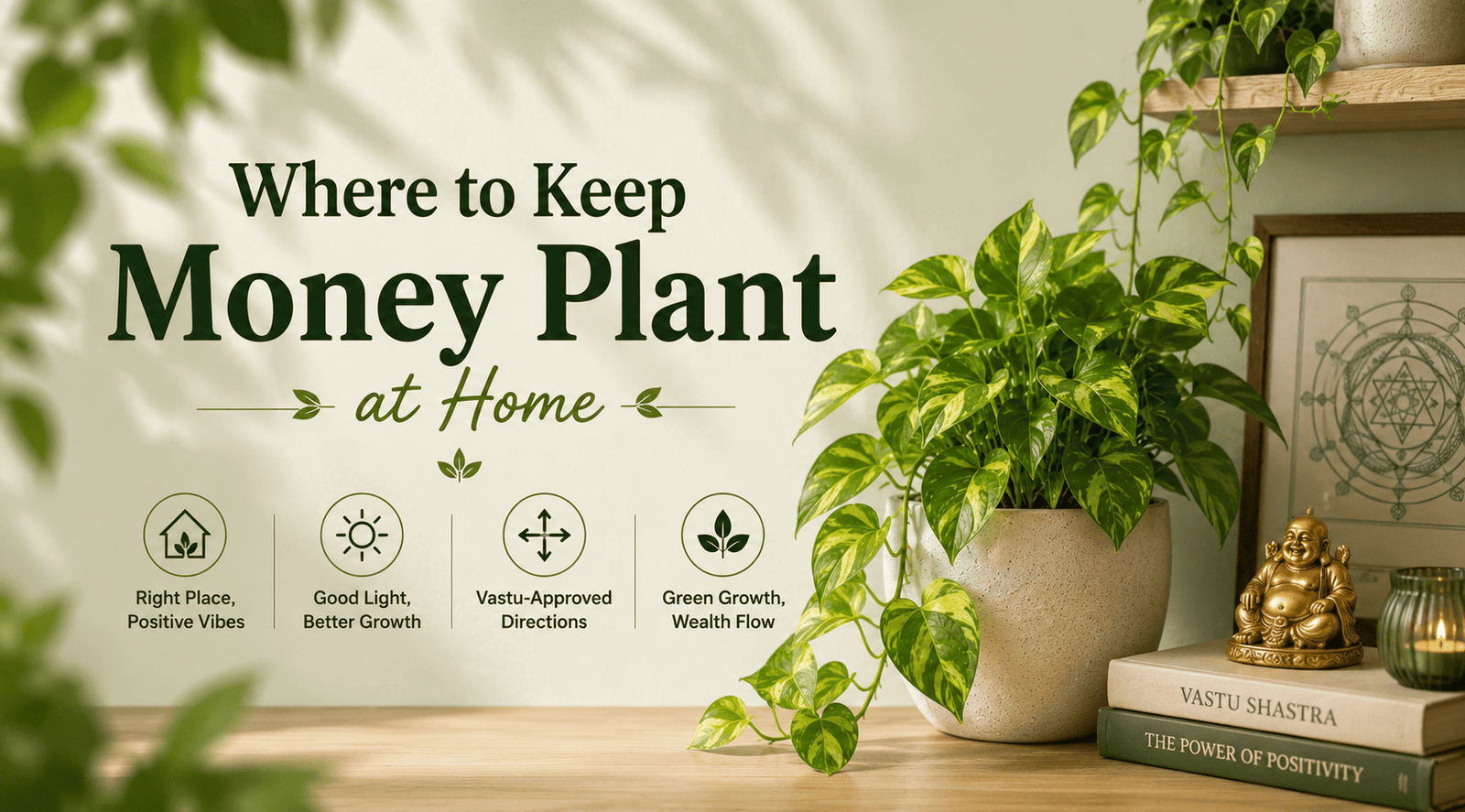
Where to Keep Money Plant at Home: Vastu, Direction & the Truth About Wealth
By PlantDecoder | Vastu & Feng Shui
Every Indian household has a money plant story.
The Kitchen Vine
My aunt kept one in her kitchen for fifteen years, trained up a string above the window, growing so enthusiastically it eventually reached the ceiling and had to be cut back twice a year. She swore by it — not with any particular spiritual conviction, but because her kitchen felt alive in a way it didn't before, and because the plant had become part of the rhythm of her home.
The Desk Cutting
My colleague at my first job kept one on her office desk in a small glass jar of water. No soil, no fuss, just a single cutting with roots trailing in the water. She'd had it for six years when I met her. Six years, the same cutting, the same jar, the same desk.
The Vastu Search
And then there's my mother's neighbour — a deeply Vastu-conscious woman who repositioned her money plant three times in one year trying to get the direction exactly right, convinced that the placement was the difference between prosperity arriving and not.
Three people. Three money plants. Three completely different relationships with the same trailing green vine.
This blog is for all three.
What Is Money Plant, Actually?
First, a clarification that matters more than you'd think.
In India, "money plant" almost universally refers to Epipremnum aureum — the trailing vine with heart-shaped, waxy leaves, also called pothos or devil's ivy. It's the one you see in every home, every office, every auto repair shop, every temple gift stall. Green, golden, variegated — all the same species, different varieties.
In other parts of the world, "money plant" can refer to Crassula ovata (jade plant) or Pachira aquatica (money tree). These are completely different plants with different Vastu and feng shui associations.
When this guide says "money plant," we mean Epipremnum aureum — the pothos — which is what 99% of people in India mean when they use the term.
The Vastu Direction: Where Should You Actually Keep It?
This is the question that brings most people to this topic, so let's answer it clearly before going deeper.
The correct Vastu direction for money plant is North or East.
North Direction (Kubera)
North is governed by Kubera — the deity of wealth and prosperity in Vastu cosmology. Placing wealth-associated plants in the north activates the energetic support of Kubera. This is the most commonly recommended direction.
East Direction (Indra)
East is governed by Indra — associated with health, solar energy, and new beginnings. Placing money plant in the east connects it to growth energy and the vitality of morning light.
What to absolutely avoid:
South direction — In Vastu, the south is governed by Yama and is associated with endings and discipline. The south is not an appropriate direction for prosperity plants.
West direction — Less critical than south, but not ideal for wealth plants either.
Never outdoors
This is one of the clearest Vastu rules about money plant. It is strictly an indoor plant in Vastu terms. The energy it's meant to cultivate is domestic — it belongs inside the home, not outside.
The Direction of Growth Matters as Much as the Direction of Placement
Here's the nuance that most guides miss, and it's actually more important than which wall you put the plant against.
Train to Grow Upward
In Vastu, the direction of a plant's growth carries symbolic and energetic meaning. A money plant trained to climb — up a moss pole, up a trellis, up a wall — represents rising fortune, upward movement, growth in the right direction.
Trailing Downward
A money plant trailing down from a shelf toward the floor? In Vastu terms, this symbolises declining energy — wealth moving downward and away.
This is a simple fix with meaningful symbolic resonance: give your money plant something to climb. A simple moss pole, a small trellis, even a wooden stake. Train the new growth upward and secure it gently as it extends.
Also critical: the vines should never touch the ground. A money plant whose tendrils have reached the floor and are trailing along it is specifically considered inauspicious. Keep the growth elevated.
Room by Room: Where Money Plant Works (and Doesn't)
Evaluating placements across the home based on Vastu energy flow and functional suitability:
Living Room — Best Choice
The living room is the most common and most appropriate Vastu placement for money plant. Place it in the north or east corner, train it upward, and let it grow. The living room is where the home's social energy is centred, and the prosperity associations of the money plant are well-suited to a shared family space.
Kitchen — Acceptable
Many Indian homes keep money plant in the kitchen, and this works reasonably well. The north or east wall of the kitchen is the best position. Keep it away from the gas stove (heat, fumes) and direct cooking steam.
The kitchen money plant in a glass jar of water — the single cutting, roots visible, placed on the window ledge — is one of the most ubiquitous indoor plant images in India. If your kitchen window faces north or east, this is entirely Vastu-appropriate.
Bedroom — With Caution
Traditional Vastu is cautious about plants in the bedroom in general — the active, growing energy of plants can disturb the restful quality of a sleeping space. Money plant in the bedroom is a specific point of debate among Vastu practitioners.
If you want it in the bedroom, place it in the east or north corner, keep it small, and make sure it's not directly beside where you sleep.
Bathroom — No
The bathroom in Vastu is associated with drainage and waste energy. Keeping a prosperity plant in a space associated with things flowing away is considered counterproductive at best. Keep money plant out of the bathroom.
Near the Main Door — Also No
This surprises many people, but money plant is not recommended for the main door or entrance in Vastu — that spot belongs to tulsi and flowering plants. Money plant is an interior plant, and Vastu is specific about this.
The Glass Jar vs. Soil Debate
Across India, the most common way to keep money plant is in a glass jar or bottle of water — a single cutting with roots, no soil required. This is also the method most associated with the money plant's "luck" reputation.
Does it work? As a growing method, absolutely. Pothos is one of the few plants that genuinely thrives indefinitely in water. The roots adapt to aquatic conditions, the plant continues to grow, and a clear glass jar shows off the root system in a way that's actually beautiful.
From a Vastu perspective, growing money plant in water introduces the water element — Jal — which in Vastu is associated with flow, abundance, and movement. Some Vastu practitioners consider this a positive amplification of the plant's prosperity energy. Others prefer soil as a more stable, earth-element container.
Practically: both work. The water method is lower maintenance (no soil to get waterlogged, no repotting), but you need to change the water weekly to prevent stagnation — which, fittingly, is exactly what Vastu is trying to avoid energetically.
The Feng Shui Perspective
In feng shui — which approaches the same plant from a different cultural tradition — money plant (pothos) is associated with the Wood element and with growth, expansion, and abundance.
Feng shui placement principles overlap with Vastu in the north direction (associated with career and life path in the feng shui Bagua, and with wealth energy more generally). The east is also positive in feng shui — associated with family and health.
One specific feng shui addition: the southeast corner of the living room is the traditional "wealth corner" in the BTB feng shui system, and placing a thriving, growing plant here is considered one of the most direct activations of wealth energy. This is different from Vastu guidance (which avoids the southeast, governed by fire).
If you're following Vastu, use north or east. If you're following feng shui, southeast is the classic wealth corner.
The Truth About Money Plants and Actual Wealth
Let's be honest about something, because this guide respects your intelligence.
No plant creates wealth. Not the money plant, not the jade plant, not the lucky bamboo.
What plants do — and what the best version of these traditions understands — is shape the environment in ways that influence how we feel and function. A home with thriving, well-placed plants is a home where someone pays attention, where things are tended, where there is order and care.
These qualities are not unrelated to prosperity. Attention, care, and intentional living are exactly the qualities that create the conditions for good things.
The ritual of watering the money plant, of training its vines upward, of placing it in a considered direction — these are practices that cultivate mindfulness about the home. And mindfulness about the home tends to correspond, in a completely non-mystical way, with homes that function well.
This doesn't diminish the tradition. If anything, it deepens it.
Quick Answers: Money Plant Vastu Questions
Direct answers to common questions about money plant placement, care, and Vastu direction:
Which direction should money plant face in Vastu?
Can money plant be kept in the bedroom?
Should money plant grow up or down?
Can money plant be kept in water or does it need soil?
Is money plant good for the main entrance?
What happens if money plant dies?
Harmonize Your Money Plant with PlantDecoder
Instantly scan your pothos to verify care requirements, water quality, and precise Vastu directional placement in your home.
A Simple Guide to Getting It Right
If you want to do this properly without overthinking it:
That's it. Everything else is refinement.
The money plant that thrives is the one that's tended.
Whatever tradition you're drawing from, that part is universal.
Stop Guessing. and Start Rescuing.
Join over 1,000+ plant parents who have permanently eliminated watering anxiety. Access instant Gemini AI leaf diagnostics and custom environmental care systems completely free.