Spider Plant and Cats: Is It Really Safe? (The Answer Might Surprise You)
By PlantDecoder | Plant Safety & Prevention
My neighbour called me in a panic last March.
Her cat — a large, opinionated ginger tabby named Mango — had eaten most of a spider plant she'd been growing for two years. Not nibbled. Eaten. Stalks, leaves, the trailing babies, basically the whole thing.
And now Mango was sitting on the floor looking extremely pleased with himself while doing something that could only be described as... swaying slightly.
"Is he going to be okay?" she asked me. "He looks drunk."
Here's the thing: he was fine. Mango was absolutely, completely fine. He just looked a little silly for a few hours and then slept it off.
But here's what's interesting — my neighbour didn't know that. And she spent three hours convinced she'd accidentally poisoned her cat, because nobody had ever properly explained what "spider plant + cat" actually means.
This blog is that explanation.
The Short Answer (For the Panicking Cat Owner Reading This Right Now)
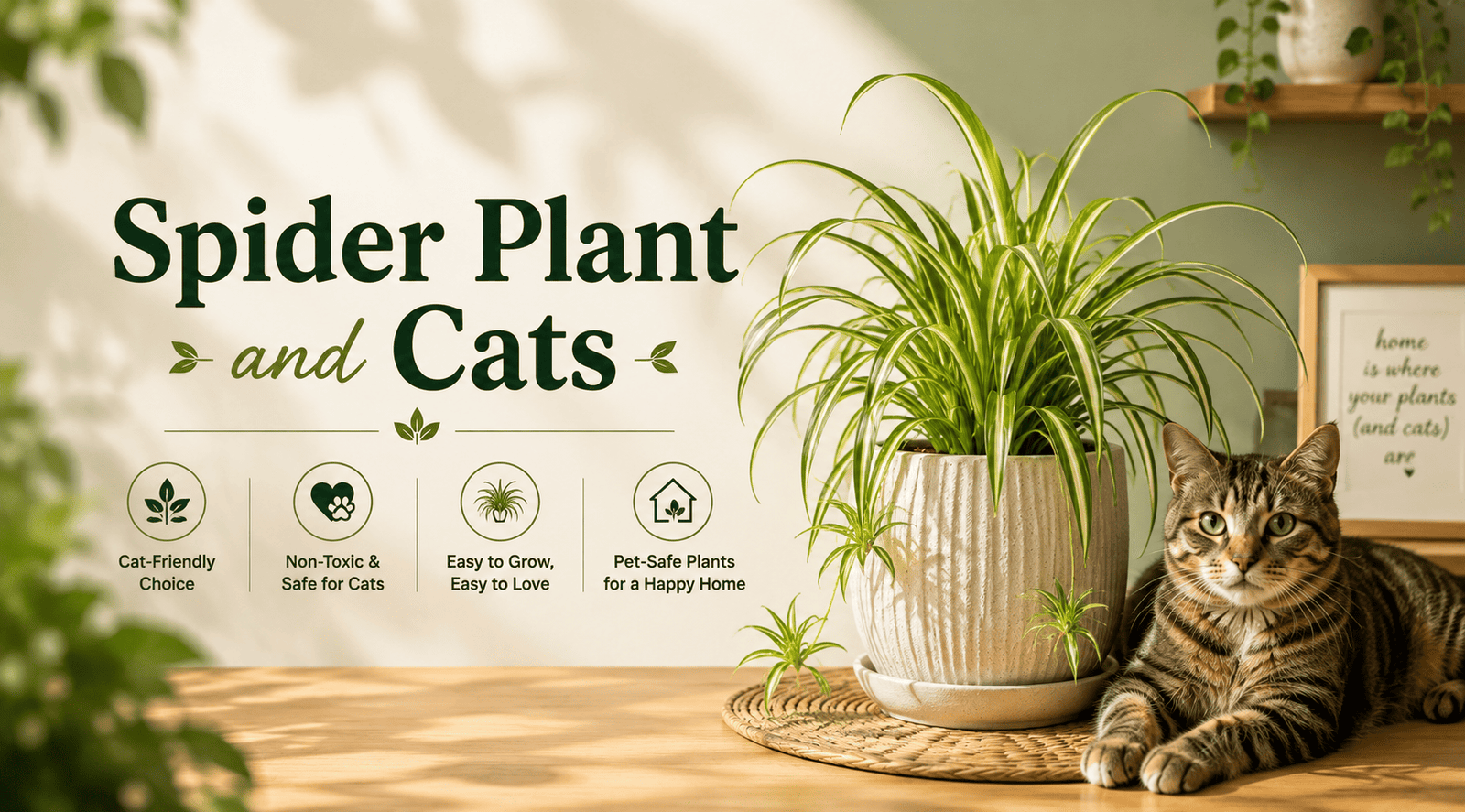
Spider plants are not toxic to cats.
According to the ASPCA — the most widely referenced authority on pet plant toxicity — Chlorophytum comosum (spider plant) is non-toxic to both cats and dogs.
If your cat has eaten a spider plant, they are almost certainly going to be fine. You may see mild stomach upset or loose stools if they ate a lot of it, but this is the plant matter itself passing through their system — not a toxic reaction.
Breathe. Then keep reading, because the full picture is more interesting than just "safe/not safe."
Why Does My Cat Keep Eating the Spider Plant?
This is the question that actually puzzles most people, because cats are famously indifferent to most things — and yet spider plants seem to have some kind of hold over them.
The reason is chemical.
Spider plants produce compounds called hallucinogenic alkaloids that are structurally similar to the compounds in catnip (Nepeta cataria). Not identical — the effect is milder — but similar enough that cats find them genuinely attractive. The plant has a smell and flavour that triggers the same curious, playful, slightly-out-of-it response that catnip does in susceptible cats.
Not all cats respond to catnip, and not all cats respond to spider plants. It comes down to genetics — roughly 50-70% of cats have the genetic sensitivity to these compounds. If your cat is obsessively targeting your spider plant, they're in the sensitive group.
This is why Mango was swaying. He wasn't poisoned. He was mildly, temporarily, completely harmlessly high on spider plant.
What Actually Happens If a Cat Eats a Spider Plant
Here's the honest breakdown of what you might see:
If they ate a small amount (a few leaves):
Nothing, or a brief period of playful, slightly loopy behaviour. Most cats eat some, feel pleasantly strange, and move on with their lives.
If they ate a moderate amount:
Mild vomiting or loose stools within a few hours. This is the stomach's response to processing plant material — not a toxic reaction. It resolves on its own.
If they ate a large amount (like Mango):
The drooling, the swaying, the general air of having made some questionable life choices. Still completely harmless. Still self-resolving. Watch them for a few hours and keep water available.
When to actually call the vet:
If symptoms are severe or prolonged (more than 24 hours), if your cat is very young, very old, or has pre-existing health conditions, or if you're not 100% certain it was a spider plant. The last point matters more than anything — always identify the plant before deciding you're not worried.
The One Thing That Can Go Wrong
A Physics Problem, Not a Toxicity Problem
There is one actual hazard with spider plants and cats, and it has nothing to do with toxicity.
The trailing runners — the long, arching stems that produce the little "babies" — are exactly the right size and texture to be irresistible cat toys. A cat that plays with them can pull the entire plant down, break the pot, scatter soil, and potentially injure itself on a falling ceramic planter.
This isn't a toxicity problem. It's a physics problem. And it's solved simply: hang your spider plant somewhere your cat can see it but not reach it, or accept that the babies are going to get absolutely destroyed.
Is Spider Plant Safe for Dogs Too?
Non-Toxic to Dogs as Well
Yes. Spider plants are non-toxic to dogs as well, and dogs don't have the same attraction to the plant's compounds that cats do. A dog that eats a spider plant is usually just being a dog — chewing something because it was there, not because it was chemically interesting.
Same mild stomach upset possibility if they eat a lot. Same complete lack of real danger.
The Bigger Question: Are All "Safe" Plants Actually Safe?
This is where we go a little deeper, because the spider plant situation reveals something important about how we think about houseplant safety.
The plant was labelled "non-toxic" — which is accurate. But it still caused my neighbour three hours of panic because she didn't understand what "non-toxic" actually meant in practice, and she couldn't tell if what she was seeing (a loopy cat) was a harmless side effect or a sign of real harm.
There's a gap between "technically safe" and "I understand what's happening and I know my cat is fine."
That gap is filled by identification and information.
A lot of people don't actually know the name of every plant in their home. The spider plant my neighbour had was a gift — she'd been calling it "the stripey hanging thing." If Mango had eaten a peace lily instead, which also hangs and also trails, she would have needed to act immediately. But she didn't know the difference.
This is the most important cat safety habit you can build: know the name of every plant in your home. Not the nickname you've given it — the actual species. With that name, you can look up the toxicity in thirty seconds.
How to Keep Spider Plants AND Cats
If you want to grow spider plants despite having cats (or because of them — they're wonderful plants), here's how to do it intelligently:
Hang it.
A spider plant in a hanging planter at ceiling height gives your cat the benefit of seeing it, smelling it, and being slightly obsessed with it, while keeping the actual leaves out of reach. Most cats won't bother with something completely inaccessible.
Expect some attention.
If your cat can reach it, they will eat it. Plan for this rather than being surprised by it.
Don't worry.
Genuinely. This is one of the few houseplant situations where you get to enjoy the plant without any meaningful anxiety about your pet. Make the most of it.
Verify Any Plant's Pet Toxicity instantly
Scan any leaf using PlantDecoder to get immediate ASPCA toxicity verification, species identification, and pet safety breakdown.
Quick Answers: What People Ask About Spider Plants and Cats
Direct answers to the most common questions regarding spider plants, feline attraction, and toxicity:
Is spider plant toxic to cats?
Why is my cat eating my spider plant?
My cat ate a spider plant — what do I do?
Can spider plants make cats sick?
Are spider plants safe for dogs?
The Bottom Line
Spider plants are genuinely, reliably safe for cats and dogs. Mango was fine. Your cat will be fine.
But the more important lesson from that phone call is this: the panic didn't come from the plant being dangerous. It came from not knowing what the plant was and what its effects actually looked like.
Know your plants. Identify them properly. Build a home where you understand what's on every shelf — not just whether it's pretty.
That's the thing that actually keeps pets safe.
Stop Guessing. and Start Rescuing.
Join over 1,000+ plant parents who have permanently eliminated watering anxiety. Access instant Gemini AI leaf diagnostics and custom environmental care systems completely free.