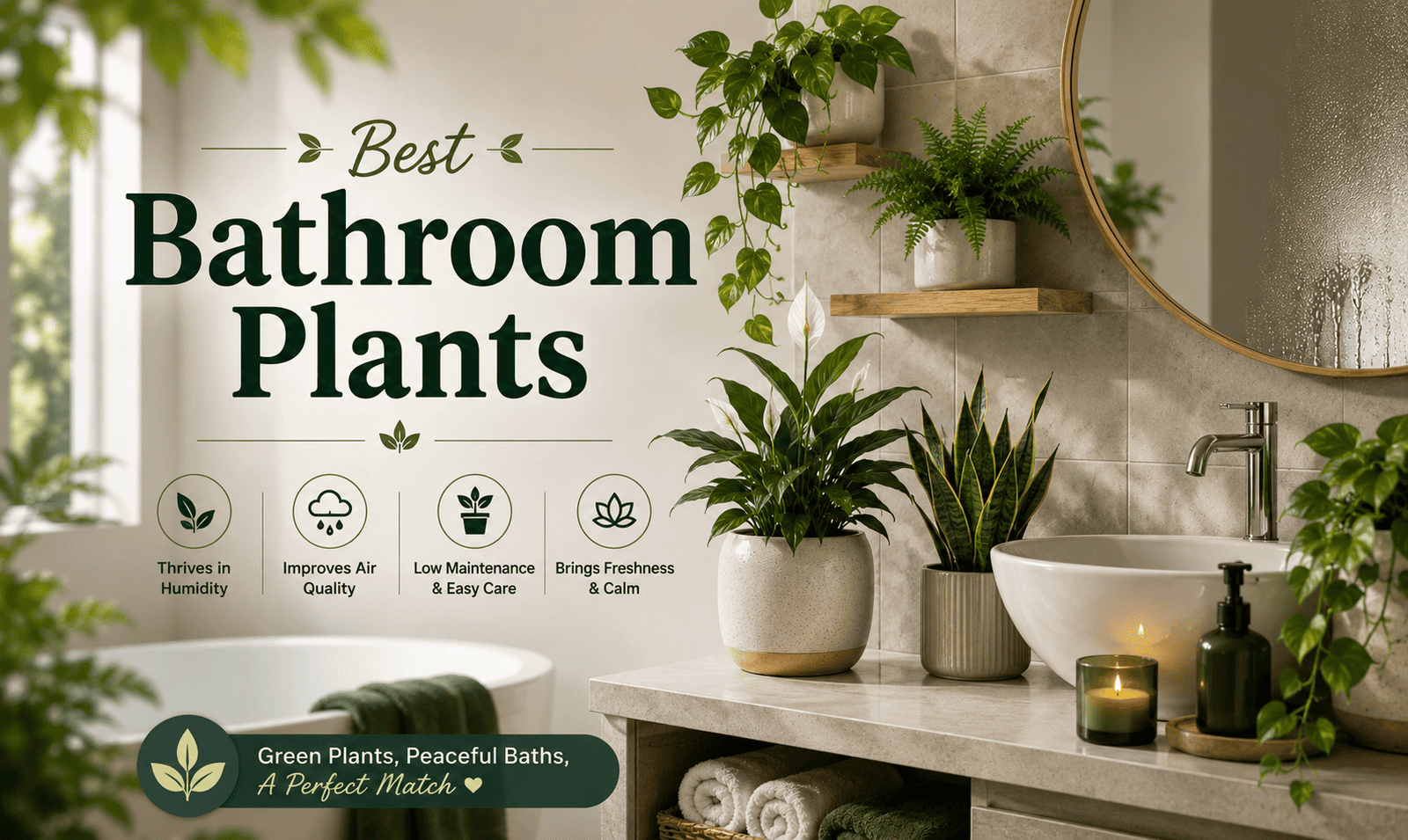
Best Bathroom Plants: The Complete Guide for Every Light Level and Size
By PlantDecoder | Last updated: 2026
The bathroom is the room everyone forgets about when they think about houseplants — and the room that arguably needs them most.
Think about it. The bathroom is where you start your morning. Where you decompress at the end of the day. Where, if you're lucky, you have a bath long enough to actually exhale. It's a space of transition, of hygiene, of small daily rituals — and it's almost always the least decorated, least considered room in the home.
A single well-chosen plant changes this completely.
There's also a practical dimension that makes bathrooms uniquely suited to certain plants: humidity. The steam from your shower creates a microclimate that tropical plants absolutely love. Plants that struggle everywhere else in your home — that sulk on windowsills and brown at the tips — will thrive in a bathroom. The environment does half the work for you.
The catch, of course, is light. Most bathrooms have limited natural light, sometimes no window at all. And temperature swings — from cold mornings to steamy showers — can be challenging for plants that like consistency.
This guide gives you the full picture: the best plants for every bathroom type, how to make them thrive, and the design principles that transform a bathroom from a functional space into a genuinely restorative one.
Understanding Your Bathroom's Conditions
Before choosing plants, spend a moment honestly assessing what you're working with. Bathroom conditions vary enormously, and the right plant for a sun-drenched en suite is completely different from the right plant for a windowless powder room.
Light Assessment
Humidity Assessment
Size Assessment
The steam from your shower creates a microclimate that tropical plants absolutely love — the environment does half the work for you.
The Best Bathroom Plants: By Category
For High Humidity Bathrooms
1. Boston Fern (Nephrolepis exaltata)
If you've ever struggled to keep a Boston Fern alive — too much brown crispy edge, too much drama — you haven't tried it in a bathroom.
The Boston Fern is a humidity addict, and the bathroom is its natural habitat. In a steamy bathroom, the plant that everyone complains is "difficult" becomes entirely manageable. The lush, cascading fronds — sometimes growing to 90cm or more — create exactly the tropical atmosphere that makes bathrooms feel like a retreat rather than a utility room.
2. Air Plants (Tillandsia)
Air plants are the ultimate bathroom plant — literally designed by evolution to live in humid, airy conditions with minimal soil and fuss.
Tillandsia are epiphytes: they absorb moisture and nutrients through their leaves rather than roots, meaning they need no soil at all. You can mount them on driftwood, nestle them in shells, place them in glass globes, or simply set them on a shelf. In a humid bathroom, they absorb the moisture from the air after every shower and need almost nothing else from you.
3. Peace Lily (Spathiphyllum)
The peace lily is one of those plants that looks like it should be difficult — elegant white blooms, glossy dark leaves — but is actually remarkably low-maintenance. It loves shade, it loves humidity, and it will tell you when it needs water by drooping dramatically and then perking up within hours of being watered.
It's one of the most effective air-purifying plants available, removing benzene, formaldehyde, and ammonia from indoor air. In a bathroom where cleaning products are used regularly, that's a meaningful bonus.
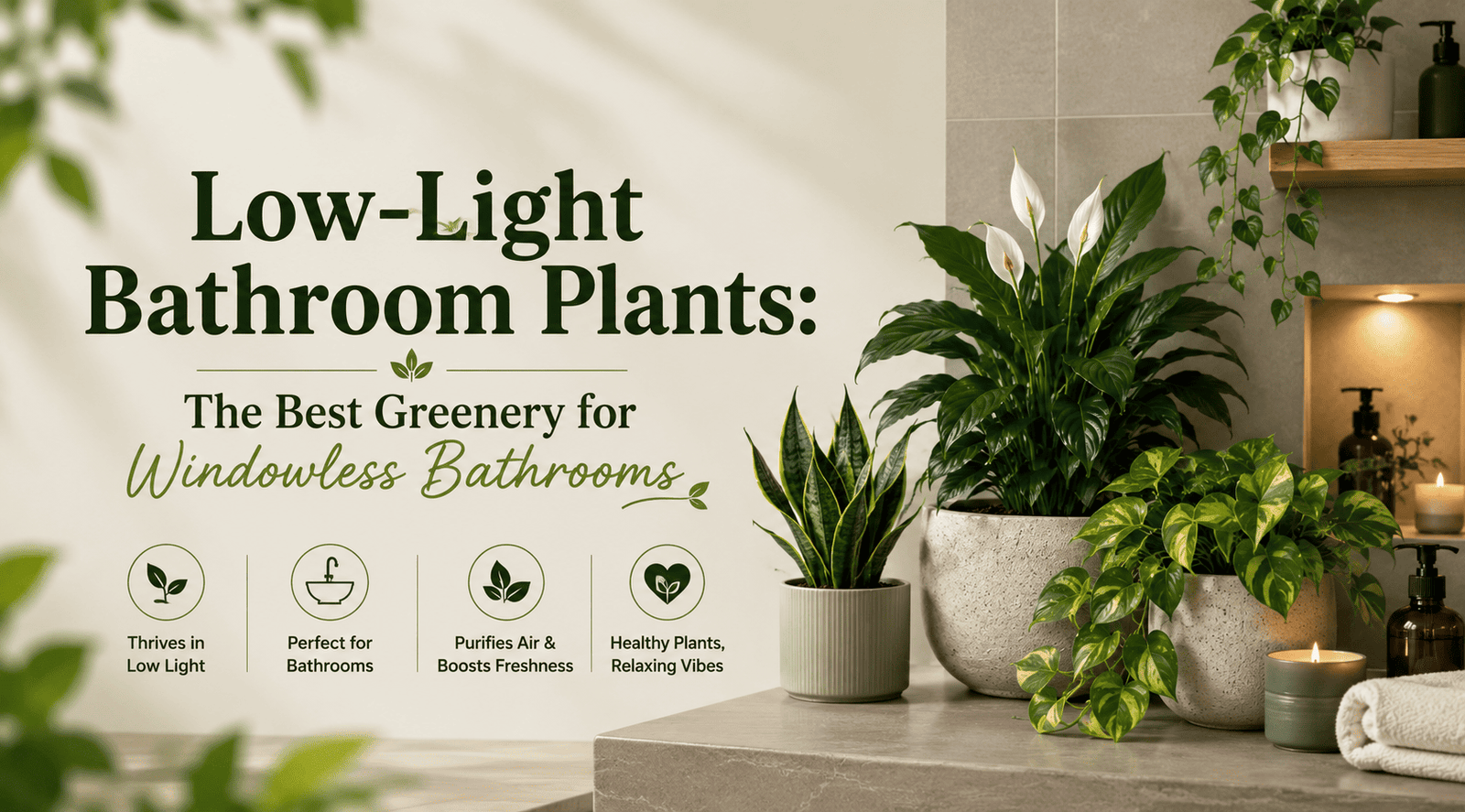
For Low-Light and Windowless Bathrooms
4. Snake Plant (Sansevieria / Dracaena trifasciata)
If you have a windowless bathroom and want a plant that has any chance of survival, the snake plant is your most reliable ally.
It tolerates lower light than almost any other plant, requires infrequent watering (overwatering kills it far more often than underwatering), and has an upright, architectural quality that works in small spaces. It releases oxygen at night, making it particularly appropriate for bathrooms where ventilation is limited.
For a windowless bathroom, supplement with a small grow light on a timer — even 8 hours of artificial bright light per day makes a significant difference to plant health and options.
5. Pothos (Epipremnum aureum)
Pothos is the most forgiving plant in existence. It tolerates low light, irregular watering, humidity swings, and complete neglect with an equanimity that borders on the supernatural. It will grow in a windowless bathroom under artificial light. It will trail beautifully from a high shelf. It will climb a small trellis if you encourage it.
For a beginner bathroom plant, or for the bathroom where survival is the primary goal, pothos is the answer.
6. Calathea (Calathea spp.)
Calatheas have a reputation for being diva plants — temperamental about water quality, humidity, and drafts. The reputation is earned. But in a bathroom, many of their demands are met automatically by the environment, which is why a calathea that struggles everywhere else often thrives in a bathroom.
The extraordinary patterned leaves — Calathea orbifolia's silver-green circles, Calathea roseopicta's dark green with pink markings, Calathea zebrina's striped velvet — make them genuinely stunning bathroom plants.
For Small Bathrooms
7. Potted Herbs: Basil, Mint, and Eucalyptus
The small bathroom benefits most from plants that do double duty — looking good and serving a purpose.
A small pot of fresh eucalyptus hung from the shower head (with the stems tied in a bundle, not immersed in water) releases its essential oils in the steam, creating a spa-like aromatherapy effect. It's the simplest, cheapest bathroom upgrade you can make.
Fresh mint on the bathroom windowsill provides fragrance and can be used — practically and instantly — whenever you need it. Basil similarly.
8. Lucky Bamboo (Dracaena sanderiana)
Lucky bamboo — often associated with feng shui and good fortune — is one of the best small bathroom plants because it grows in water, requires almost no light, and stays compact and tidy indefinitely.
Bathroom Plant Design Principles
Key spatial strategies to transform functional bathrooms into spa-like sanctuaries using plants:
The Rule of Three Heights
The most visually satisfying bathroom plant arrangements use three heights: a floor plant (if space allows), a mid-height plant on a stool or shelf, and a hanging or trailing plant. This creates vertical movement and makes the space feel more layered and intentional.
For a small bathroom: skip the floor plant and focus on the mid-height and hanging element.
Pot Selection Matters More in Bathrooms
The bathroom is a small space, which means every detail is visible. Invest in pots that feel considered. Matte terracotta, concrete, ceramic, and rattan basket covers all work well. Avoid cheap plastic pots unless they're hidden inside a more attractive outer pot.
Water-resistant pots (ceramic, glazed) are practical in a bathroom environment. Terracotta is beautiful but will develop moisture marks over time — which some people find charming and others don't.
Use Shelving
Wall-mounted shelving is the most space-efficient way to add plants to a small bathroom. A simple wooden shelf at mid-height holds multiple small plants and gets them close to whatever light source exists. Floating corner shelves use space that's otherwise dead in a bathroom.
Plants as Privacy
In bathrooms with frosted or opaque windows, a row of tall plants on the sill creates an additional visual screen without sacrificing all available light. Snake plants, bamboo palm, and pothos all work well for this.
Maintaining Bathroom Plants: The Practical Guide
Because bathroom microclimates hold moisture longer, care routines must be tailored specifically to avoid root issues:
Bathroom plants in high-humidity environments dry out much more slowly than the same plants elsewhere. Adjust your watering schedule — a plant that needs water weekly in your living room may only need it every two weeks in a steamy bathroom.
The number one killer of bathroom plants is overwatering compounded by humidity. When in doubt, stick your finger in the soil. If it's still moist an inch down, wait.
In bathrooms where cleaning products and hairspray are used, leaves accumulate a film over time that blocks light absorption. A monthly wipe with a damp cloth makes a surprising difference.
While humidity helps plants, stagnant humid air can encourage fungal issues. Ensure your bathroom has reasonable airflow — open a window or run the exhaust fan regularly.
If plants are only receiving light from one direction (a single window), rotate the pot a quarter turn each week so all sides receive equal light and the plant grows evenly.
Diagnose & Care for Your Bathroom Plants Instantly
Use PlantDecoder to identify lighting requirements, diagnose overwatering signs, and schedule customized care for high-humidity plants.
Quick Answers: What People Ask About Bathroom Plants
Direct answers to the most common questions regarding bathroom plant selection, windowless conditions, and moisture management:
What are the best plants for a bathroom with no window?
Do plants really grow in bathrooms?
Which plants are best for absorbing bathroom odours?
Are there plants that can grow in a shower?
Can I put a plant on the bathroom floor?
How do I stop my bathroom plants from getting mouldy?
What plants are safe for a family bathroom with children and pets?
Bathroom Plant Care Calendar
The Bathroom Jungle: A Room Worth Investing In
The bathroom is where your day begins and ends. It's the room where you're most alone with your thoughts, most stripped back from the performance of the day. And it's the room that, more than almost any other, benefits from the presence of living things.
A well-placed fern, a trailing pothos, an air plant in a glass globe — these things don't just make a bathroom look better. They change how it feels to be in it.
Start with one plant. Put it somewhere it can be seen from where you brush your teeth. Notice how different the room feels with something alive in it.
Then get another one.
Stop Guessing. and Start Rescuing.
Join over 1,000+ plant parents who have permanently eliminated watering anxiety. Access instant Gemini AI leaf diagnostics and custom environmental care systems completely free.